

1. The Hidden Costs of Legacy Machinery in Modern Plant Floors
PLANT EFFICIENCYOutdated mechanical quilting and taping systems are notorious for micro-downtime, frequent thread breakage, and sluggish cycle times. These compounding delays create severe work-in-progress (WIP) pileups across assembly cells, starving downstream packaging stations and failing to meet daily delivery quotas.
Operational Analysis: Bottleneck Identification
- Downtime Accumulation: Legacy equipment requires constant manual intervention for tension resets and jam clearance, eating up to 30% of available shift hours.
- Technical Solution: Modern automated machinery incorporates closed-loop feedback and robust servo systems to maintain continuous runtime without operator babysitting.
Economic Impact: Scrap Reduction
- Material Waste Factor: Older mechanical linkages often slip during high-speed acceleration, resulting in warped quilting patterns and costly fabric scrap.
- Technical Solution: Rigid bridge frames and direct-drive digital controls ensure zero-tolerance accuracy across every production run.
2. Harnessing Servo-Driven Controls to Eliminate Operator Inconsistencies
MOTION CONTROLRelying on veteran operators to manually calibrate tension, stitch length, and corner deceleration introduces massive variability between shifts. Implementing digital multi-axis servo architecture standardizes execution, ensuring identical output regardless of the shift crew.
Engineering Analysis: Axis Synchronization
- Precision Control: Multi-axis servo drives synchronize roller movement and needle stroke with microsecond accuracy, preventing puckering at high speeds.
- Technical Solution: Eliminating mechanical gears and clutches drastically reduces backlash and maintenance overhead while boosting top-end operating speeds.
Labor Optimization: Skill-Level Adaptation
- Operator Dependency: Manual adjustments demand years of specialized craftsmanship, making plants vulnerable to labor shortages and turnover.
- Technical Solution: Touchscreen PLC interfaces store thousands of pattern presets, allowing novice operators to run complex configurations safely.
3. Maximizing Quilting Throughput: Transitioning to High-Speed Quilting Lines
QUILTING PERFORMANCEThe quilting department is the ultimate heartbeat of mattress manufacturing. Slow single-head machines choke panel supply, forcing downstream assembly lines to starve and miss strict delivery schedules.
Operational Parameter: Cycle Acceleration
- Throughput Limitation: Standard reciprocating heads hit severe inertia walls above 1,500 RPM, restricting hourly panel output.
- Technical Solution: Integrating heavy-duty German Durkopp heads and balanced rotary hook boxes elevates operational velocity to 3,000 RPM.
Structural Integrity: Vibration Dampening
- Vibration Toll: High-speed oscillation creates structural resonance that misaligns needles and triggers premature component wear.
- Technical Solution: Heavy-gauge fabricated steel bases and linear guide rails absorb kinetic forces to maintain pristine stitch formation under continuous load.
4. Streamlining Edge-Closing Operations with Fully Automated Tape Edge Systems
TAPE EDGE AUTOMATIONManual mattress taping requires operators to physically lift, push, and rotate heavy mattresses across the table—a grueling ergonomic hazard that severely limits per-hour productivity and causes inconsistent corner finishes.
Ergonomic Factor: Operator Fatigue
- Technical Solution: Robotic arms and pneumatic flipping mechanisms automate 90-degree rotations, keeping operators fresh and productive.
Speed Parameter: Corner Deceleration
- Corner Bottlenecks: Operators often overshoot corners or jam tape binders when attempting to maintain high speeds around tight perimeters.
- Technical Solution: PLC-controlled automatic deceleration slows the sewing head precisely at corners before accelerating back to peak velocity on straightaways.
Essential Machinery for Scaling Production

Designed for high-volume mattress production featuring a German DURKOPP head, automatic thread break detection, and 360-degree jump-stitch capabilities.
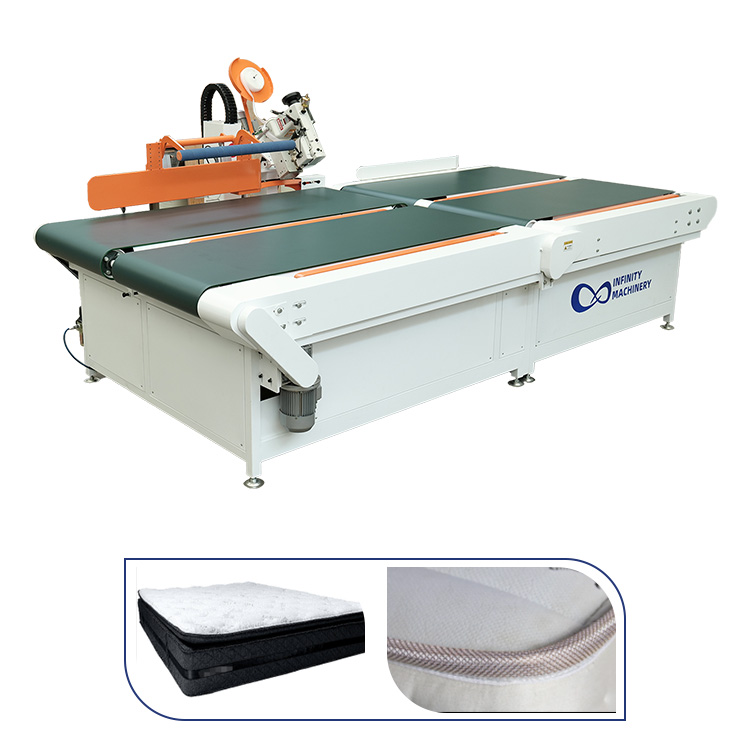
Fully automatic high-speed tape edge machine featuring automated 90-degree turning, robotic arm handling, and precise PLC program control.
5. Reducing Material Scrap and Fabric Friction Through Advanced Tension Regulation
MATERIAL MANAGEMENTHigh-loft multi-layer quilting sandwiches are highly susceptible to stretching and puckering if web tension is poorly managed during feeding. Maintaining uniform tension prevents material skewing and ensures clean panel separation downstream.
Material Property: Tension Control
- Feeding Skew: Uneven pull from stationary creels creates wavy panels that jam automatic cutting and flanging units.
- Technical Solution: Servo-regulated feed rollers maintain exact fabric tension from start to finish, eliminating material distortion.
Operational Parameter: Sensor Integration
- Thread Ruptures: Undetected upper or lower thread snaps result in long stretches of unstitched panels before discovery.
- Technical Solution: Advanced infrared and optical sensors instantly detect thread breaks, halting the machine immediately to prevent defective output.
6. Minimizing Unplanned Downtime via Robust Mechanical Maintenance
MAINTENANCE & UPTIMEComplex machinery requires disciplined maintenance protocols to sustain peak output. Designing factories around modular, easily accessible components prevents minor mechanical friction points from cascading into plant-wide shutdowns.
Diagnostic Protocol: Lubrication & Wear
- Frictional Wear: High-speed reciprocating parts generate heat and friction that accelerate bushing and bearing degradation.
- Technical Solution: Centralized automatic lubrication systems deliver measured oil doses directly to critical friction points during operation.
- Service Delays: Servicing intricate sewing heads or shuttle assemblies often requires hours of tedious bolt removal and realignment.
- Technical Solution: Modular drop-in sewing heads and precision dowel alignment pins allow maintenance teams to swap assemblies in minutes.
7. Achieving Maximum Return on Investment Through Plant Floor Integration
FINANCIAL ROITransitioning toward a fully optimized Smart Factory & Automatic Mattress Production Line transforms capital expenditure into immediate operational savings. By slashing labor headcount per shift and doubling daily bed output, plant owners achieve rapid payback periods.
Financial Metric: Cost-Per-Bed
- Labor Overhead: Manual handling inflates direct labor costs and creates severe throughput caps during peak seasonal demand.
- Technical Solution: Automation reduces headcounts per production cell while multiplying daily output, directly slashing the manufacturing cost per mattress.
Strategic Advantage: Scalability
- Capacity Limits: Fragmented standalone machines prevent plants from scaling up to meet major contract bids from hospitality and retail giants.
- Technical Solution: Integrated production lines provide predictable, uninterrupted output that scales effortlessly with growing market demand.
Strategic Investment Takeaway
Replacing slow, legacy manual operations with automated, reliable equipment is the definitive strategy for reducing cost-per-bed, maximizing output per shift, and securing long-term factory profitability in a competitive global market.
Ready to Optimize Your Factory Throughput?
Consult with our manufacturing engineers to design a custom high-yield production line tailored to your plant's output goals.


