

1. The Hidden Liabilities of Legacy Mechanical Quilting Equipment
Operational BottlenecksAging mechanical quilting rigs rely heavily on worn cams, mechanical linkages, and manual operator calibration, resulting in sluggish cycle times and high fabric scrap rates. Factory owners face chronic downtime due to frequent mechanical slip, inconsistent stitch tension, and an over-reliance on veteran operators who are difficult to replace.
Operational Friction Analysis
- Mechanical Wear Factor: Legacy drive shafts and mechanical clutches degrade over time, leading to cumulative pattern drift and misaligned quilting passes across multi-layer panels.
- Technical Solution: Modern servo-driven architectures replace mechanical linkages with direct digital control, eliminating backlash and ensuring precise needle positioning during every cycle.
2. Achieving Rigorous Dimensional Stability via Servo-Driven Controls
Dimensional StabilityMaintaining exact panel dimensions is critical for downstream automated assembly and tape-edge operations. When multi-layer quilted panels stretch or skew under high-speed sewing, assembly lines jam and finished beds fail quality inspection tolerances.
Engineering Analysis
- Material Tension Fluctuation: High-loft quilting materials naturally resist uniform feeding, causing puckering and dimensional distortion on traditional fixed-speed rollers.
- Technical Solution: Utilizing multi-axis closed-loop servo systems synchronizes roller feed rates and carriage movement, locking fabric dimensions within millimeter tolerances.
3. Elevating Surface Aesthetics with High-Precision Needle Penetration
Surface AestheticsRetail buyers judge mattress premium quality primarily by surface tactile feel and visual crispness of intricate quilting patterns. Inconsistent stitch formation or skipped loops instantly downgrade a luxury model into a budget tier.
Material Property
- Stitch Definition Challenge: Complex 360-degree jump-stitch patterns demand ultra-precise needle timing to prevent thread shredding when transitioning across dense foam layers.
- Technical Solution: Integrating premium imported sewing heads with automated thread trimming and dynamic presser foot adjustment guarantees flawless stitch depth and knot security.
4. Mitigating Fabric Distortion and Material Scrap During High-Speed Runs
Scrap ReductionFabric slippage between upper quilted ticking, inner batting, and backing material destroys raw material value. Every ruined panel directly inflates the plant's cost-per-bed overhead and eats into net manufacturing margins.
Manufacturing Parameter
- Layer Slippage Root Cause: Unbalanced pressure distribution across wide quilting widths causes upper fabric layers to creep ahead of bottom backing sheets.
- Technical Solution: Advanced computerized tensioners and precision linear guide rails clamp materials uniformly throughout the sewing envelope, cutting material scrap to near zero.
5. Integrating Advanced Thread Break Detection for Uninterrupted Shifts
Production EfficiencyOperators running legacy machines spend countless hours inspecting long quilting runs for broken threads, leading to ghost stitches, unraveled panels, and significant lost production time per shift.
Diagnostic Factor
- Invisible Stitch Faults: Undetected upper or lower thread snaps force complete panel rejection or manual repair, halting continuous workflow.
- Technical Solution: High-speed infrared thread break sensors instantly detect tension loss, automatically pausing the machine and alerting operators before flawed panels propagate down the line.
Essential Machinery for Scaling Production

High-efficiency single-needle quilting machine featuring a German DURKOPP head, automatic thread break detection, and 360° jump-stitch capability for premium stable production.
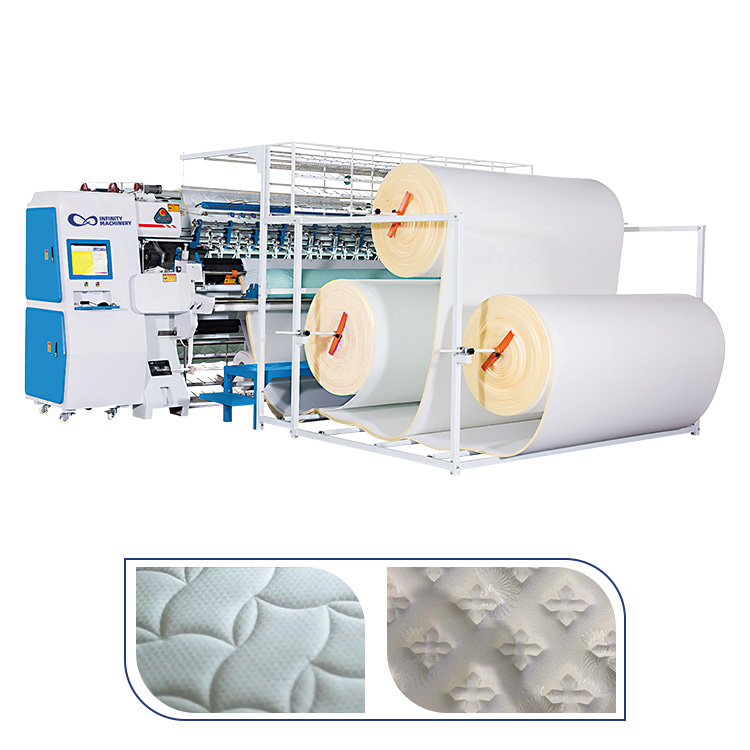
Advanced multi-needle quilting machine equipped with servo-driven rollers, new shuttle guide rail support, and infrared thread break detection for high-volume output.
6. Optimizing Factory Throughput and Lowering Cost-Per-Bed Metrics
Plant ProfitabilityFactory scaling relies heavily on maximizing output per square meter of floor space while compressing labor overhead. Upgrading core workstations transforms output bottlenecks into streamlined profit drivers.
Economic Evaluation
- Throughput Multiplier: Higher operating speeds combined with automated pattern switching drastically elevate daily bed output per shift.
- Technical Solution: Implementing robust mattress quilting solutions allows manufacturers to reduce operator headcount per line while simultaneously scaling finished product volume.
7. Long-Term Maintenance Simplicity and Structural Durability
Equipment ReliabilityComplex machinery often introduces maintenance headaches, but modern industrial design prioritizes modular component placement, self-lubricating systems, and accessible spare parts to secure maximum uptime.
Maintenance Protocol
- Downtime Prevention: Manual lubrication oversights and unsealed bearing assemblies cause premature component seizure in harsh factory environments.
- Technical Solution: Centralized automated lubrication and heavy-duty fabricated steel frames ensure sustained operational stability, minimal servicing requirements, and extended machinery lifespan.
Strategic Plant Investment Takeaway
Replacing slow, legacy manual quilting operations with automated, reliable equipment like Infinity Mattress Machinery is the definitive strategy for reducing cost-per-bed, maximizing output per shift, and securing long-term factory profitability.
Ready to Upgrade Your Factory Line?
Consult with our engineering specialists to design a customized production layout tailored to your facility's output goals.


