

1. The Architectural Shift from Mechanical Linkages to Multi-Axis Servo Control
Servo ArchitectureTraditional manufacturing relies on physical cam shafts and gear linkages that suffer from mechanical backlash, thermal expansion, and inevitable wear over millions of operational cycles. Modern high-performance machinery replaces these friction-heavy physical constraints with dedicated servo motors governing individual axes. This architectural shift ensures absolute synchronization between needle movement, material feeding, and rotational positioning.
Engineering Analysis: Motion Synchronization
- Mechanical Constraint: Legacy gear trains introduce timing lags and vibration at high speeds, limiting practical operating rpm and accelerating component fatigue.
- Technical Solution: Direct-drive multi-axis servo systems eliminate mechanical backlash, allowing real-time trajectory correction and maintaining stitch integrity even during rapid directional changes.
Operational Parameter: Torque Delivery
- Torque Profile: Heavy-duty quilting and taping require consistent torque across variable material densities without stalling or slipping.
- Technical Solution: Closed-loop servo feedback dynamically adjusts motor torque output based on real-time load resistance from multi-layer quilted panels.
2. Overcoming the Hidden Costs of Aging Legacy Machinery
Plant EfficiencyOperating legacy, worn-out equipment introduces massive hidden financial drains into a manufacturing plant. Frequent breakdowns, excessive thread breakage, and high fabric scrap rates erode operating margins, while dependency on veteran operators who understand the quirks of aging machines creates severe operational vulnerability. Upgrading to modern automated systems resolves these issues at the root.
Diagnostic Factor: Material Scrap and Downtime
- Maintenance Reality: Worn guide rails and loose mechanical tolerances cause skipped stitches, irregular panel dimensions, and ruined fabric batches.
- Technical Solution: Modern automated machinery utilizes rigid fabricated steel frames and linear guides that maintain strict geometric tolerances over years of heavy industrial use.
Economic Impact: Operator Dependency
- Labor Bottleneck: Legacy machines demand constant manual intervention, calibration, and tuning by highly specialized, expensive technicians.
- Technical Solution: Intelligent digital controls and touch-screen PLC interfaces standardize operations, enabling semi-skilled personnel to achieve consistent, zero-defect output.
3. Real-Time Digital Integration and Touch Screen PLC Interfaces
Digital ControlDigital integration transforms a standalone workshop floor into a synchronized production environment. By centralizing machine parameters, pattern selection, and diagnostic monitoring through intuitive touch-screen interfaces, plant managers can execute rapid product changeovers and monitor operational efficiency in real time.
Interface Parameter: Changeover Speed
- Operational Challenge: Manual mechanical adjustments for varying mattress thicknesses and border dimensions consume valuable production shift hours.
- Technical Solution: PLC-driven touch screens store hundreds of custom programs, enabling instant parameter recall and automated mechanical height adjustments.
Diagnostic Insight: Fault Detection
- Monitoring Gap: Hidden thread breaks or minor sensor misalignments often go unnoticed until an entire panel is compromised.
- Technical Solution: Advanced infrared and optical sensor arrays instantly detect thread anomalies or material jams, halting the machine automatically to prevent cascade damage.
4. Maximizing Hourly Throughput through Synchronized High-Speed Dynamics
Production SpeedAchieving profitable unit economics in modern bedding manufacturing requires aggressive cycle-time reduction without compromising structural integrity. Synchronizing the sewing head shaft speed with high-acceleration roller feeds enables unprecedented linear output speeds per shift, directly multiplying daily bed production.
Dynamic Parameter: Shaft Acceleration
- Speed Limit: Conventional sewing heads experience severe thermal stress and needle deflection when pushed beyond moderate operating thresholds.
- Technical Solution: Integrated automatic lubrication systems and balanced rotary hook boxes allow sustained high-speed operation up to 1,400 RPM and beyond.
Throughput Metric: Continuous Operation
- Efficiency Drain: Manual intervention for oiling, thread trimming, and material positioning creates persistent micro-stoppages.
- Technical Solution: Automated thread trimming, pneumatic clamping, and continuous feeding mechanisms sustain high linear production rates of 300+ meters per hour.
Essential Machinery for Scaling Production
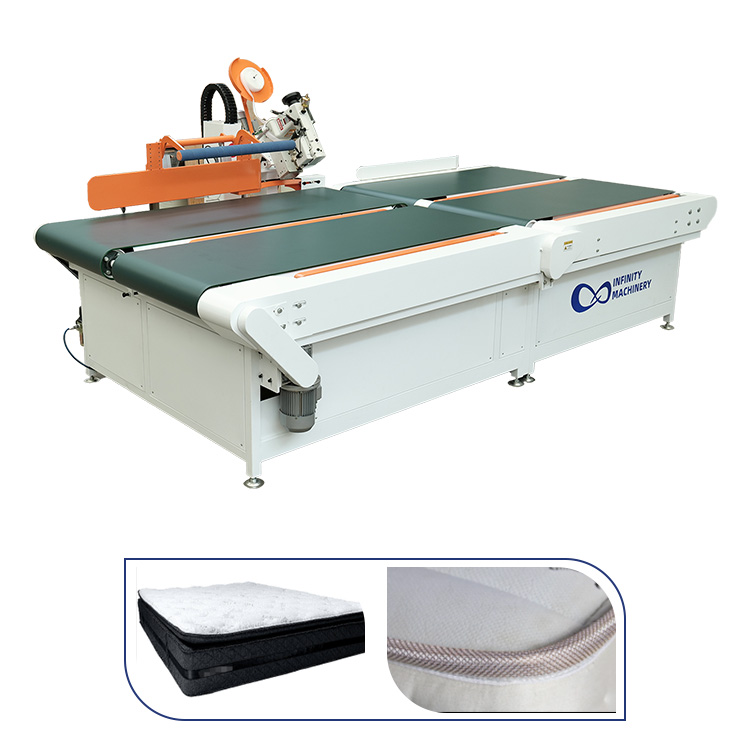
Fully automatic high-speed tape edge machine featuring a robotic arm, automatic flipping, and PLC control to eliminate labor bottlenecks and ensure aesthetic, straight sutures.

Advanced quilting machine combining a 0.5-inch needle distance, border slitting device, and space-saving integrated console for high-volume, precision quilting.
5. Advanced Motion Profiling and Automatic Corner Deceleration
Precision SewingExecuting complex 360-degree jump patterns and crisp corner turns on thick mattress panels requires sophisticated motion profiling. Standard motors overshoot trajectory targets during sharp turns, leading to needle breakage and distorted stitching. Servo-managed motion profiles calculate deceleration curves dynamically.
Geometric Parameter: Corner Deceleration
- Corner Distortion: High-speed linear travel without programmed deceleration rounds off corners and snaps needles against heavy internal wadding.
- Technical Solution: PLC software automatically decelerates carriage feed rates prior to directional nodes, ensuring razor-sharp corner definition and uniform stitch density.
Pattern Accuracy: Jump Stitch Integrity
- Stitch Slippage: Complex multi-needle quilting patterns demand absolute synchronization between needle entry and fabric advancement.
- Technical Solution: Digital encoder feedback guarantees exact needle drop placement down to sub-millimeter tolerances across multi-layer high-loft materials.
6. Reducing Labor Headcount via Automated Material Handling
AutomationLabor scarcity and escalating wage pressures make manual material handling unsustainable for high-capacity factories. Integrating automated conveyor systems, robotic flipping arms, and vacuum stacking units into a smart factory layout drastically reduces physical labor requirements while accelerating work-in-progress transfer times.
Operational Parameter: Material Transfer
- Labor Bottleneck: Manually lifting, rotating, and feeding heavy multi-layer mattresses causes severe operator fatigue and production delays.
- Technical Solution: Integrated pneumatic conveyors and automated turning mechanisms handle heavy bedding components smoothly without manual strain.
Workflow Integration: Output Stacking
- Handling Inefficiency: Piling finished panels or quilted fabric manually creates bottlenecks at the end of high-speed production lines.
- Technical Solution: Servo-controlled stacking units automatically organize and pile finished materials up to high vertical limits, maintaining an orderly workflow.
7. Long-Term Mechanical Durability and Maintenance Simplicity
Plant MaintenanceIndustrial machinery must endure grueling multi-shift operating schedules with minimal unplanned downtime. Equipment design must prioritize structural rigidity, accessible lubrication ports, and modular component replacement to ensure a rapid return on capital investment and straightforward maintenance routines.
Engineering Principle: Structural Rigidity
- Vibration Stress: High-speed reciprocating sewing heads generate intense harmonic vibrations that loosen fasteners and warp inferior frames over time.
- Technical Solution: Heavy-gauge welded steel frames combined with precision linear guide rails absorb operational vibration and maintain alignment indefinitely.
Maintenance Parameter: Routine Servicing
- Downtime Risk: Complex, hard-to-reach mechanical assemblies make routine lubrication and belt tensioning a time-consuming chore for maintenance crews.
- Technical Solution: Automated oiling systems, easily accessible modular drive units, and clear diagnostic fault codes minimize servicing windows and maximize machine uptime.
Strategic Investment Takeaway
Transitioning from labor-intensive legacy equipment to automated, multi-axis servo-driven machinery is no longer optional for competitive bedding manufacturers. By investing in advanced industrial solutions from Infinity Mattress Machinery, factory owners dramatically reduce cost-per-bed, maximize output per shift, and secure long-term operational profitability.
Ready to Upgrade Your Factory Floor?
Consult with our manufacturing specialists to design a high-efficiency production line tailored to your exact plant capacity and output goals.

