

1. Diagnostic Protocols for Wire Feed Friction and Slippage
Diagnostic StepWire feed slippage directly compromises coil height consistency and leads to severe structural defects in pocket and Bonnell spring units. Factory engineers must routinely inspect feed rollers for grooving, metallic debris buildup, and uneven clamping pressure caused by high-speed frictional wear.
Mechanical Friction Analysis
- Root Cause Identification: Accumulated carbon dust and steel shavings inside feed grooves create micro-slips, resulting in irregular wire feed lengths.
- Technical Solution: Implement scheduled pneumatic cleaning and calibrate roller pressure tolerances to maintain optimal traction without scoring the high-tensile steel wire.
Operational Parameter Monitoring
- Speed Correlation: Excessive feed speeds without matching roller grip adjustments accelerate premature thermal wear on drive gears.
- Technical Solution: Use closed-loop servo monitoring systems to automatically detect torque spikes and micro-stalls before mechanical failure occurs.
2. Establishing Precision Calibration for Coiling Head Alignment
Mechanical CalibrationMisaligned coiling heads generate asymmetrical springs, jamming the assembly tooling and wasting raw high-carbon steel wire. Regular alignment checks ensure that the forming point, cutter, and guide pins maintain micron-level precision during continuous high-speed cycling.
Tooling Geometry Check
- Wear Vector: Constant impact between the coiling point and high-tensile wire causes gradual edge rounding and dimensional drift.
- Technical Solution: Utilize optical alignment gauges during weekly maintenance shifts to reset tool clearances to manufacturer specifications.
Axis Synchronization
- Timing Variance: Mechanical backlash in multi-axis drives leads to erratic pitch and loose coil formatting.
- Technical Solution: Re-zero servo motor offsets and verify encoder feedback loops to guarantee flawless synchronization across all operational axes.
3. Comprehensive Lubrication Schedules for High-Stress Bearings
Lubrication ScheduleHigh-speed mattress spring machines operate under intense mechanical loads, generating significant frictional heat that breaks down standard lubricants. Establishing a strict, automated greasing schedule prevents bearing seizure, reduces motor load, and preserves smooth operational dynamics.
Grease Viscosity & Application
- Thermal Breakdown: Inadequate or incorrect grease types liquefy under high operating temperatures, leaving critical needle bearings dry and vulnerable.
- Technical Solution: Apply high-temperature, extreme-pressure (EP) synthetic greases using calibrated auto-lubricators to maintain protective film integrity.
Interval Optimization
- Contamination Risk: Over-lubrication attracts ambient metallic dust, forming an abrasive sludge that accelerates seal and shaft wear.
- Technical Solution: Follow strict micro-dose lubrication intervals tailored to shift output volume rather than arbitrary calendar dates.
4. Identifying Early Signs of Metal Fatigue and Component Wear
Wear AnalysisCatastrophic machine breakdowns are almost always preceded by subtle vibrational anomalies, minor acoustic shifts, and hairline fractures in reciprocating components. Catching these early indicators during routine inspections prevents costly emergency repairs and prolonged line stoppages.
Vibration Diagnostics
- Dynamic Imbalance: Unbalanced cams and worn spindle housings create high-frequency vibrations that degrade surrounding mechanical linkages.
- Technical Solution: Deploy portable vibration analyzers to detect imbalance signatures before they compromise main shaft stability.
Visual Inspection Protocols
- Micro-Cracking: High-stress arms and cutter levers are prone to fatigue cracks under continuous multi-shift production pressure.
- Technical Solution: Use dye-penetrant testing on critical load-bearing parts every quarter to detect microscopic stress fractures early.
5. Optimizing Tensioner Assemblies to Prevent Wire Distortion
Tension ControlWire tensioners govern the smoothness of wire delivery into the coiling chamber. Improper tension profiles cause wire twisting, uneven coiling diameters, and frequent jamming that halts production and ruins raw material batches.
Guide Pulley Friction
- Groove Etching: High-tensile steel wire rapidly cuts deep grooves into unhardened guide pulleys, causing intermittent drag and tension spikes.
- Technical Solution: Replace standard pulleys with tungsten-carbide coated guides and rotate them periodically to distribute contact wear evenly.
Spring Tensioner Tuning
- Fatigue Loss: Mechanical tension springs lose their elastic memory over time, resulting in declining back-tension consistency.
- Technical Solution: Calibrate tensioner springs using precision load scales and replace them immediately upon detecting a 10% drop in holding force.
6. Replacement Thresholds: Repairing vs. Upgrading Worn Assemblies
Component ReplacementKnowing precisely when to retire a worn mechanical assembly instead of continuously patching it is vital for long-term plant profitability. Procuring certified mattress machinery spare parts & tools ensures that replacement components restore original factory tolerances without compromising output speed.
Tolerance Drift Limits
- Precision Threshold: Components exceeding a 0.05mm clearance tolerance introduce unacceptable play into the wire-feeding and cutting sequence.
- Technical Solution: Establish strict replacement guidelines based on dimensional wear limits rather than waiting for complete functional failure.
Cost-Benefit Analysis
- Downtime Economics: Frequent minor repairs of legacy sub-assemblies often cost more in lost shift productivity than a timely, complete module replacement.
- Technical Solution: Maintain an active inventory of high-wear replacement modules to enable rapid, plug-and-play swaps during scheduled maintenance windows.
7. Integrating Smart Diagnostics for Real-Time Downtime Prevention
Industrial AutomationModern automated mattress plants leverage integrated IoT sensors and PLC diagnostics to monitor motor temperatures, wire feed speeds, and lubrication pressures in real time. This shift from reactive maintenance to predictive intervention maximizes machine uptime and throughput.
Sensor Integration
- Thermal Overload: Unnoticed friction in gearboxes and bearings rapidly spikes operating temperatures before operators notice manual resistance.
- Technical Solution: Install automated thermographic sensors linked to emergency PLC interlocks to halt operations instantly upon reaching temperature thresholds.
Data-Driven Maintenance
- Operational Blind Spots: Relying on operator memory for grease intervals and belt replacements leads to missed maintenance windows.
- Technical Solution: Utilize machine-integrated cycle counters and maintenance software to automatically trigger alerts when servicing is due.
Essential Machinery for Scaling Production
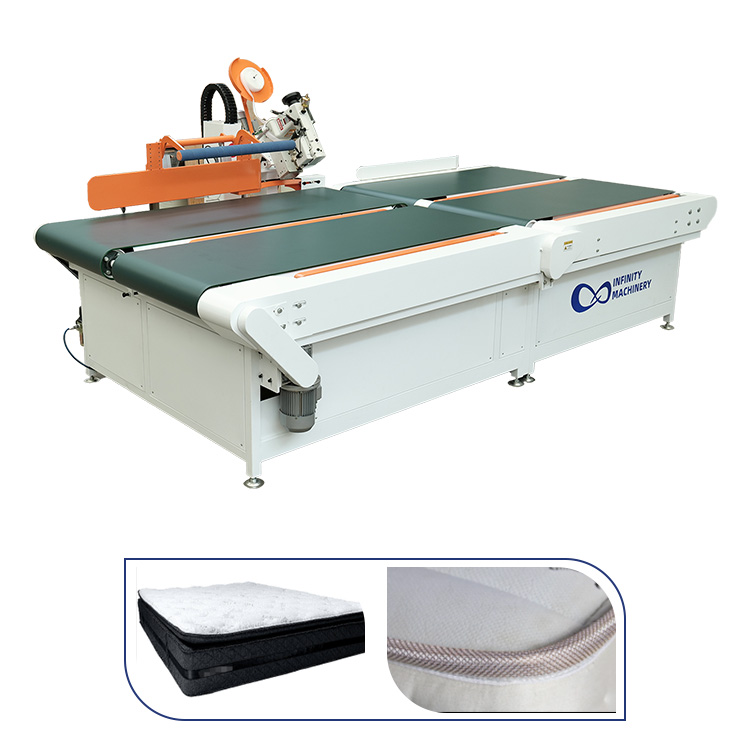
Totally automatic high-speed tape edge machine featuring automatic rotation, flipping, and robotic arm assistance to maximize finishing efficiency and reduce labor.

High-efficiency automatic quilting machine equipped with a German DURKOPP head and automatic thread break detection for complex 360° patterns.
Investor Takeaway & Operational Excellence
Implementing a rigorous preventative maintenance schedule for wire feeding systems, tensioners, and lubrication points is the cornerstone of profitable mattress manufacturing. By eliminating unexpected mechanical failures, reducing scrap rates, and partnering with robust equipment builders like Infinity Mattress Machinery, factory owners can secure maximum per-shift output, minimize cost-per-bed, and guarantee long-term operational profitability.
Ready to Upgrade Your Factory Line?
Contact our engineering experts today for a customized plant layout, production speed analysis, and high-efficiency machinery quote.


