

1. The Hidden Bottlenecks of Legacy Spring Coiling Equipment
Legacy Equipment AnalysisOutdated mechanical clutch systems and worn-out cam linkages severely limit hourly output, leading to frequent micro-stoppages and high maintenance overhead. Plant managers relying on vintage coiling machines face escalating downtime, inconsistent spring geometry, and severe dependency on scarce, skilled mechanical operators.
Operational Bottleneck Assessment
- Mechanical Wear & Cycle Delay: Legacy cam-driven linkages experience severe mechanical fatigue at speeds exceeding 50 coils per minute, triggering frequent jams.
- Technical Solution: Replacing mechanical clutches with direct-drive servo architectures eliminates backlash and stabilizes the coiling rhythm to maintain continuous 100-coil-per-minute velocity.
2. High-Speed Servo Controls and Mechanical Velocity
Servo Drive DynamicsAchieving 100 coils per minute requires replacing erratic mechanical linkages with multi-axis servo motors that govern wire feeding, coiling, and knotting with absolute synchronization. This digital precision eliminates backlash, stabilizes the coiling rhythm, and ensures uniform spring height across multi-ton production runs.
Velocity & Synchronization
- Axis Synchronization: Independent servo drives control the feeding roller and coiling head simultaneously to prevent pitch deformation at maximum speeds.
- Technical Solution: Implementing closed-loop digital feedback loops instantly corrects micro-variations in wire tension, guaranteeing strict dimensional tolerances.
3. Wire Feeding Precision and Tension Management
Tension ControlHigh-velocity wire ingestion creates severe friction and vibration risks that distort spring diameter if unmanaged. Advanced tensioners maintain consistent drag force from full coil spools down to the final meters, preventing wire deformation and ensuring optimal tensile strength in every hourglass spring.
Material Ingestion
- Dynamic Drag Force: Uncontrolled spool momentum causes wire surging and inconsistent knot formation during high-speed acceleration phases.
- Technical Solution: Integrating active pneumatic brake tensioners ensures steady wire delivery and uniform torsional rigidity across every single manufactured spring unit.
4. Thermal Dissipation and Continuous Duty Cycles
Thermal ManagementContinuous 24/7 operation generates intense frictional heat within the coiling head and drive gearboxes, which can cause dimensional drift if thermal expansion is ignored. Modern machinery incorporates optimized cooling channels, forced-air dissipation, and premium alloy gear assemblies to sustain peak speeds without thermal seizing.
Thermal Stability
- Heat Accumulation Risk: Unchecked gearbox temperatures cause metal expansion, leading to binding tolerances and premature bearing failure.
- Technical Solution: Advanced industrial machinery utilizes automated oil-circulation cooling systems and heavy-duty alloy housings to dissipate frictional heat effectively.
Essential High-Speed Machinery for Modern Plants

Advanced quilting machine combining innovative features like 0.5-inch needle distance, border slitting device, and space-saving integrated console for high-efficiency production.
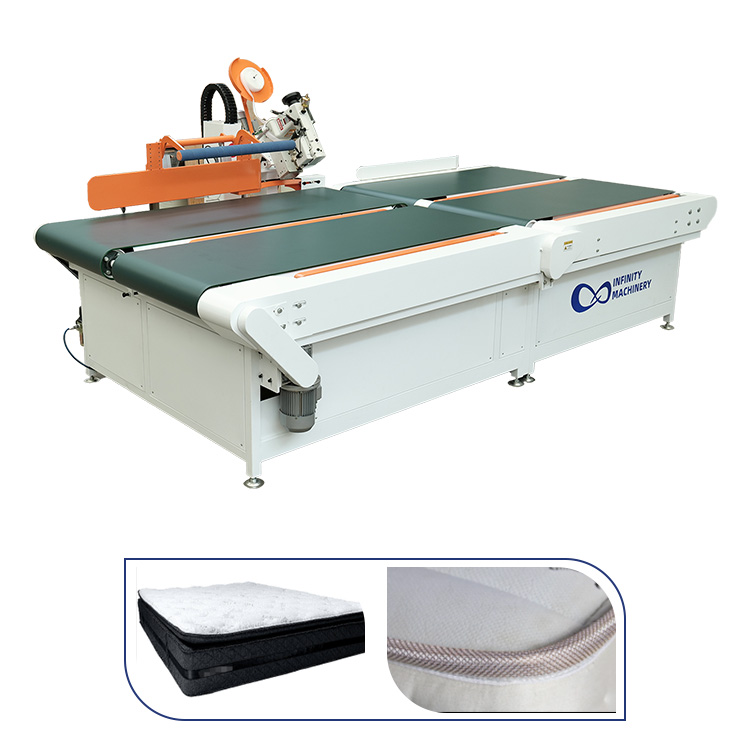
Totally automatic high-speed tape edge machine featuring automatic rotation, flipping, robotic arm assistance, and robust PLC control to drastically reduce labor intensity.
5. Minimizing Wire Scrap and Material Waste
Material EfficiencyHigh-speed coiling must be balanced against raw material consumption to protect gross operating margins. Precise digital calibration ensures minimal tail waste during start-up and auto-correction phases, directly reducing costly steel wire discard over thousands of production cycles.
Scrap Reduction Parameters
- Yield Optimization: Inaccurate feeding increments result in unusable wire remnants and inflated raw material expenses per shift.
- Technical Solution: Utilizing precision encoder feedback guarantees exact wire cutting lengths, slashing scrap rates to near-zero levels.
6. Operator Independence and Reduced Labor Overhead
Labor OptimizationOperating legacy mattress machinery requires continuous manual intervention, constant tension tweaking, and skilled mechanical adjustments. Modern automated lines integrate smart touch-screen interfaces and automated fault detection, allowing a single operator to oversee multiple high-speed production cells safely.
Workforce Deployment
- Operator Skill Dependency: Heavy reliance on veteran mechanics creates severe operational vulnerabilities during staffing shortages.
- Technical Solution: Intuitive PLC touch interfaces store preset production recipes, enabling rapid product changeovers with minimal operator training.
7. Routine Maintenance and Long-Term Durability
Maintenance ProtocolsLong-term operational profitability hinges on simplified routine maintenance, automated lubrication, and easily accessible wear-and-tear components. Investing in robust mattress manufacturing solutions minimizes unplanned factory downtime and extends operational lifespan by over a decade.
Reliability Engineering
- Wear Component Access: Buried or complex mechanical assemblies lead to prolonged maintenance lockouts during routine servicing.
- Technical Solution: Modular machine design allows rapid access to high-wear tooling and automated central lubrication to guarantee maximum uptime.
Strategic Manufacturing Takeaway
Transitioning from legacy coiling setups to high-speed automated systems is no longer optional for competitive bedding manufacturers. By maximizing output per shift, reducing wire scrap, and leveraging robust industrial equipment, factory owners can drastically lower their cost-per-bed and secure long-term profitability.
Ready to Scale Your Production Line?
Consult with our engineering experts to design a high-speed manufacturing setup tailored to your facility.


