

1. The Hidden Vulnerabilities of Legacy Manual Flanging Operations
Operational BottleneckManual border flanging relies heavily on veteran operator dexterity to feed non-woven fabric and mattress panels. This inconsistent handling creates uneven stitch lengths, loose over-locks, and frequent bottlenecks that stall downstream assembly lines.
Operational Analysis:
- Labor Dependency: Relying on manual guiding leads to fatigue-driven variance, causing high rejection rates and compromised seam integrity across shifts.
- Technical Solution: Implementing automatic flanging systems standardizes feeding speed and eliminates human error entirely.
2. Eliminating Fabric Slippage and Tension Inconsistencies
Tension ControlWhen stitching multi-layer border panels, uneven material tension causes puckering and distorted edges. Traditional mechanical friction devices fail to dynamically adapt to varying foam densities and quilted batting thicknesses.
Engineering Parameter:
- Friction Variance: Unregulated material drag results in bunched fabric layers and weak structural lock-stitches at stress points.
- Technical Solution: Direct-driven servo motors and adjustable fabric tension mechanisms maintain precise feeding pressure for flat, rigid edges.
3. Maximizing Shift Throughput with Automated Turning and Cutting
Throughput OptimizationLegacy workshops lose valuable production minutes whenever operators manually stop to cut threads and trim excess non-woven backing. Modern automated equipment streamlines every cycle from entry to final edge separation.
Production Efficiency:
- Cycle Drag: Manual stopping and trimming consume up to 35% of total active work-station time per mattress panel.
- Technical Solution: Integrating programmable PLC controls with automatic turning arms and thread cutters accelerates output speed drastically.
4. Achieving Uniform Corner Radius and Seam Integrity
Quality CalibrationMattress durability depends heavily on how cleanly corners are reinforced during the flanging stage. Inconsistent corner radius execution leads to weak points that fail standard structural stress audits.
Structural Parameter:
- Corner Weakness: Manual rounding often skips stitches or bunches material at 90-degree turns, resulting in premature field failures.
- Technical Solution: Advanced digital positioning coordinates needle drops and feed rates precisely, guaranteeing identical corner geometry every time.
Advanced Machinery for Flanging Line Upgrades

Features a PLC control system, automatic turning arm, and precise thread-cutting functions to ensure consistent corner radius and maximum efficiency.
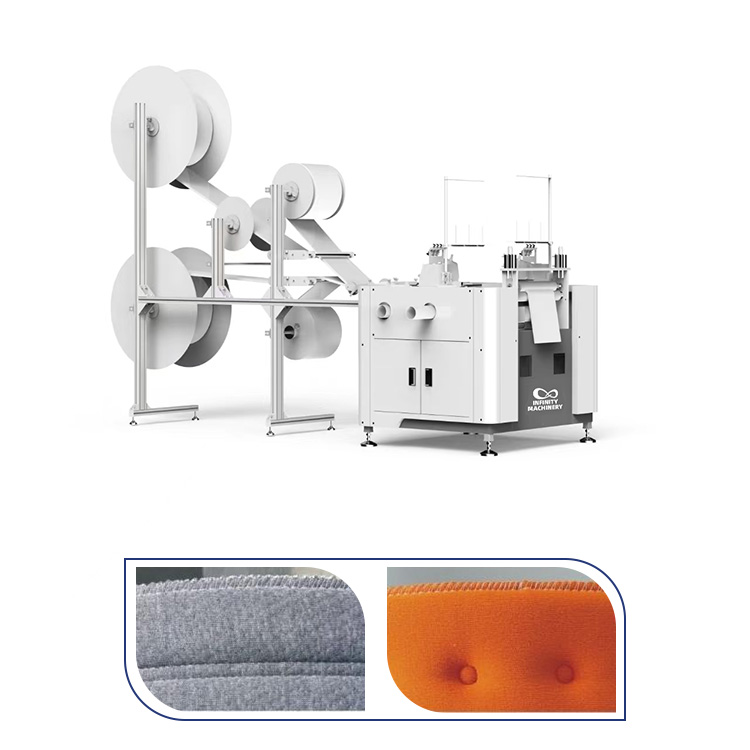
Equipped with direct-driven servo motors controlling both front and back sewing heads, delivering flawless border flanging and adjustable fabric tension.
5. Reducing Material Scrap and Thread Breakage Down-Time
Waste ReductionFrequent thread snaps and misaligned feeding produce costly bundles of discarded fabric scrap. Plant managers must address these material losses to maintain competitive mattress manufacturing solutions.
Cost Factor:
- Scrap Accumulation: Uncalibrated needle penetration tears delicate non-woven borders, instantly destroying expensive raw materials.
- Technical Solution: High-speed industrial sewing heads equipped with active thread monitoring stop instantly upon breakage, preventing jagged seam runs.
6. Operator Ergonomics and Minimizing Skill Dependencies
Workforce StabilitySevere shortages of skilled sewing technicians leave plant owners vulnerable to production delays. Relying on complex manual operations increases training overhead and lowers operational resilience.
Labor Dynamics:
- Training Bottleneck: Teaching workers manual edge manipulation takes weeks and yields inconsistent quality across different shifts.
- Technical Solution: Touch-screen digital interfaces allow operators of all skill levels to select pre-programmed parameters, ensuring immediate plant efficiency.
7. Long-Term Mechanical Durability and Low-Maintenance Design
Maintenance ProtocolContinuous high-speed manufacturing environments test the structural limits of moving mechanical parts. Choosing robust machinery minimizes unexpected workshop halts and lowers annual upkeep overhead.
Engineering Durability:
- Wear Vulnerability: Standard mechanical linkages suffer from rapid friction wear, leading to costly alignment drift and frequent part replacements.
- Technical Solution: Heavy-duty fabricated steel frames, automated oil supply systems, and servo-driven actuators ensure decades of reliable, low-maintenance operation.
Strategic Plant Investment Summary
Replacing slow, legacy manual operations with automated, reliable equipment like Infinity Mattress Machinery flanging systems is the definitive strategy for reducing cost-per-bed, maximizing output per shift, and securing long-term factory profitability.
Ready to Optimize Your Production Line?
Contact our engineering experts today for custom plant layouts and high-speed equipment quotations tailored to your manufacturing goals.


