

1. The Production Bottleneck of Legacy Manual Flanging
Operational ChallengeRelying on manual border flanging introduces severe inconsistency across factory shifts. Veteran operators struggle with maintaining uniform corner tension, leading to puckered fabric, irregular stitch lines, and heavy dependency on skilled labor that is increasingly difficult to source and retain.
Operational Parameter: Labor Dependency
- Root Defect: Manual guidance causes varying feed speeds around mattress corners, resulting in distorted border alignment and rejected panels.
- Technical Solution: Implementing automated automatic mattress flanging machines removes manual steering errors and standardizes feed rates.
Material Insight: Scrap Accumulation
- Root Defect: Inaccurate manual trimming leads to excessive non-woven fabric and thread waste during border assembly.
- Technical Solution: Digital sensors and precision edge guides cut excess material instantly to exact pre-set tolerances.
2. Engineering Uniform Corner Radii via PLC Integration
Corner PrecisionAchieving a crisp, repeatable corner radius on multi-layer mattress borders is impossible without programmable logic controllers. Modern automated systems utilize synchronized turning arms and precise digital positioning to ensure every corner matches the engineering blueprint without manual intervention.
Engineering Analysis: Servo Synchronicity
- Principle Factor: Multi-axis servo control synchronizes needle movement with the turning radius mechanism at high sewing speeds.
- Technical Solution: PLC-managed turning arms automatically decelerate upon entering the corner curve to prevent needle deflection and thread snapping.
Operational Parameter: Dimensional Repeatability
- Principle Factor: Variations in perimeter dimensions across different mattress models require rapid program switching.
- Technical Solution: Touch-screen recipe management allows operators to store and recall exact corner parameters instantly.
3. Automated Thread Trimming and Non-Woven Fabric Slicing
Trimming EfficiencyPost-sewing cleanup is a major labor sink in traditional bedding factories. Integrating automated thread trimming and edge slicing directly into the flanging cycle eliminates secondary trimming stations and accelerates overall line throughput.
Material Property: Edge Cleanliness
- Diagnostic Factor: Ragged non-woven edges compromise the integrity of subsequent tape edge and assembly stages.
- Technical Solution: High-speed integrated rotary blades shear excess non-woven backing simultaneously with the stitching process.
Technical Solution: Cycle Acceleration
- Diagnostic Factor: Manual thread snipping slows down per-unit bed completion time.
- Technical Solution: Pneumatic auto-trimmers cut thread tails to uniform lengths immediately upon seam completion.
4. Maintaining Consistent Fabric Tension Across Variable Thicknesses
Tension ControlMattress panels range from sleek low-profile memory foam models to plush pillow-tops exceeding 90mm in thickness. Flanging machines must dynamically adapt presser foot height and material tension to prevent fabric stretching or bunching.
Material Property: Compressibility Management
- Material Insight: Thick quilted borders exert uneven upward pressure against the sewing head during high-speed feeding.
- Technical Solution: Adjustable presser foot lift heights and automated tensioners maintain steady downward pressure regardless of panel bulk.
Operational Parameter: Feeding Stability
- Material Insight: Slippage between multi-layer quilt packages causes misaligned flanging seams.
- Technical Solution: Direct-drive feed mechanisms ensure synchronized top and bottom material advancement.
Advanced Flanging Machinery for Precision Plant Upgrades

Equipped with PLC control, automatic turning arm, and precise thread/non-woven fabric cutting for consistent corner radius and maximum efficiency.
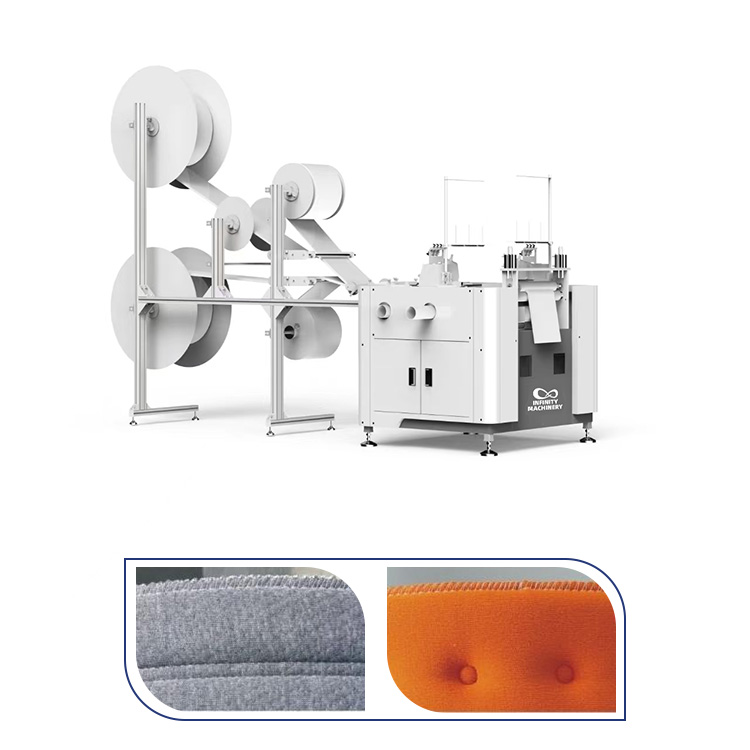
Features direct-driven servo motors, adjustable fabric tension, and dual sewing heads for high-precision border flanging across wide ranges.
5. Reducing Labor Headcount and Eliminating Material Scrap
Cost OptimizationInvesting in automated machinery is fundamentally an exercise in unit cost reduction. By minimizing fabric scrap and reallocating operators from manual guiding tasks to supervisory roles, plants rapidly improve their bottom-line profitability.
Operational Parameter: Headcount Reduction
- Efficiency Metric: Manual flanging typically demands two operators per line for heavy panel manipulation and guiding.
Material Insight: Scrap Minimization
- Efficiency Metric: Operator error in corner cutting accounts for high weekly material loss in traditional workshops.
6. Mechanical Reliability and Maintenance Simplicity
Plant MaintenanceIndustrial machinery must withstand continuous multi-shift operation without unexpected failures. Modern flanging systems utilize robust structural steel frames, direct-drive servo motors, and automated lubrication points to ensure maximum uptime and straightforward routine upkeep.
Engineering Analysis: Component Durability
- Maintenance Factor: Traditional mechanical linkages and belts suffer from stretching, slippage, and high wear rates.
- Technical Solution: Direct-driven servo architecture eliminates complex gearboxes, reducing mechanical friction points and maintenance intervals.
Operational Parameter: Lubrication Management
- Maintenance Factor: Manual oiling is frequently neglected, leading to premature sewing head seizure.
- Technical Solution: Integrated automatic oil supply systems deliver metered lubrication directly to critical high-speed sewing components.
7. Scaling Factory Output for Competitive B2B Advantage
Plant ScalingTo win large commercial hospitality and retail mattress contracts, manufacturing facilities must scale output without compromising quality standards. Standardized flanging ensures that every mattress leaving the factory meets exact dimensional specifications.
Operational Parameter: Throughput Acceleration
- Scaling Metric: Increasing daily bed output requires removing bottlenecks at the border preparation stage.
- Technical Solution: High-speed servo flanging dramatically increases linear output meters per hour, matching upstream quilting capacity.
Engineering Analysis: Quality Assurance Integration
- Scaling Metric: High rejection rates at final inspection destroy profit margins on high-volume orders.
- Technical Solution: Precision digital sensors and fault-detection mechanisms flag sewing irregularities before panels advance to assembly. Partnering with the Infinity Mattress Machinery Official Website gives plant managers access to turnkey solutions designed for modern industrial scale.
Executive Investment Takeaway
Upgrading legacy manual border operations with automated, high-precision flanging machinery is the definitive strategy for reducing cost-per-bed, minimizing material scrap, and securing long-term factory profitability. By standardizing corner radii and eliminating operator-dependent trimming errors, plant owners can reliably scale output to meet demanding commercial contracts.
Ready to Upgrade Your Mattress Production Line?
Consult with our engineering experts to find the ideal automated machinery solutions for your manufacturing plant.


