

1. Metallurgy and High-Frequency Wire Tempering
Metallurgical IntegrityHigh-carbon steel wire undergoes rigorous thermal treatment to achieve the ideal balance of tensile strength and elasticity before entering the coiling zone. Inconsistent metallurgical tempering leads to spring distortion, uneven coil diameters, and premature structural failure in finished mattress cores.
Material Property:
- Induction Heating Uniformity: High-frequency thermal management ensures consistent carbon structure alignment across the entire wire length, preventing weak spots.
- Technical Solution: Advanced tension-regulated feeding mechanisms maintain constant pulling force during thermal transitions, eliminating micro-fractures and guaranteeing uniform spring rebound.
2. Servo-Driven Pitch Precision and Helix Formation
Pitch PrecisionAchieving exact knot angles and consistent hourglass geometry requires absolute synchronization between the wire feeding rollers and the coiling cam. Legacy mechanical linkages suffer from backlash and thermal expansion, resulting in irregular pitch and compromised ergonomic support across production shifts.
Engineering Analysis:
- Multi-Axis Servo Synchronization: Replacing mechanical cams with independent servo drives delivers sub-millimeter precision during helix formation and knot closing.
- Technical Solution: Real-time digital feedback loops dynamically adjust cam positioning to compensate for wire memory and springback, ensuring strict adherence to dimensional tolerances.
3. Eliminating Legacy Bottlenecks: Why Upgrading Old Coiling Machines Drives Plant Profitability
Equipment UpgradeOperating legacy coiling equipment incurs hidden operational costs through frequent mechanical jams, high wire scrap rates, and heavy reliance on veteran mechanics. Transitioning to modern automated machinery stabilizes production schedules and slashes unit manufacturing costs.
Operational Parameter:
- Mechanical Wear in Legacy Units: Worn gears, slack clutches, and manual adjustment points cause frequent downtime and inconsistent spring heights that halt downstream assembly lines.
- Technical Solution: Upgrading to modern automated systems eliminates manual calibration bottlenecks, ensuring continuous shift output and seamless integration into an automatic mattress production line.
4. High-Speed Output and Hourly Yield Maximization
Throughput OptimizationMaximizing factory profitability requires high operational velocity without sacrificing structural integrity or spring firmness. Modern coiling systems integrate high-speed wire straightening and rapid knotting heads to drastically elevate daily bed output per shift.
Production Parameter:
- High-RPM Shaft Dynamics: Pushing main shaft rotation speeds higher requires balanced rotating masses to maintain stable wire feeding and prevent tangling.
- Technical Solution: Optimized kinematic designs reduce mechanical inertia, allowing for sustained high-speed operation essential for specialized mattress spring manufacturing machines.
Essential Machinery for Scaling Production

High-efficiency automatic single-needle quilting machine featuring German DURKOPP head and automatic thread break detection for stable production.
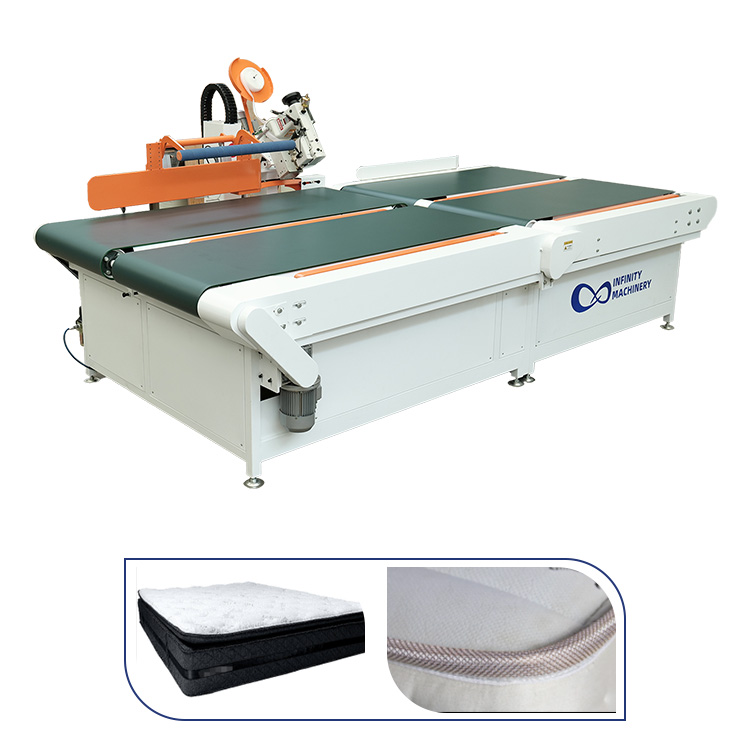
Totally automatic high-speed tape edge machine featuring automatic rotation, flipping, and robotic arm assistance for maximum throughput.
5. Structural Rigidity and Vibration Dampening in High-RPM Coiling
Structural StabilityOperating at thousands of rotations per minute generates severe mechanical vibration that can degrade coiling precision and accelerate component wear. Heavy-duty cast iron frames and precision-ground linear guides absorb operational kinetic energy to maintain micro-tolerance output.
Engineering Analysis:
- Kinetic Energy Dampening: Uncontrolled frame vibration leads to cam wear, pitch drift, and premature bearing failure in high-speed machinery.
- Technical Solution: Reinforced chassis designs and optimized mass distribution isolate vibration, ensuring decades of stable, high-precision mechanical performance under continuous multi-shift operation.
6. Reduced Operator Dependency and Automated Error Detection
Automated MonitoringProduction consistency should not depend entirely on the intuition of veteran operators. Intelligent diagnostic systems monitor wire feed rates, detect knotting anomalies, and halt operation instantly upon detecting wire depletion or mechanical jams.
Diagnostic Step:
- Real-Time Fault Sensing: Infrared and digital sensors identify misfeeds, wire breaks, and tension drops before they cause multi-spring jams or tool damage.
- Technical Solution: Intuitive touchscreen interfaces allow instant recipe loading and automated error logging, reducing operator training time and eliminating manual setup errors.
7. Preventive Maintenance Protocols and Long-Term Component Durability
Maintenance SimplicityMinimizing unplanned downtime depends on straightforward maintenance access and robust, wear-resistant components. Centralized automatic lubrication systems and easily replaceable cutting heads ensure the plant keeps running profitably with minimal intervention.
Operational Parameter:
- Component Wear Management: High-friction zones such as wire guides and cutting blades experience rapid degradation if manual lubrication schedules are neglected.
- Technical Solution: Integrated automated oiling systems and modular tool designs streamline routine upkeep, reducing maintenance windows and maximizing overall equipment effectiveness (OEE).
Securing Long-Term Manufacturing Profitability
Replacing slow, legacy manual operations with automated, reliable equipment like Infinity Mattress Machinery is the definitive strategy for reducing cost-per-bed, maximizing output per shift, and securing long-term factory profitability.
Ready to Upgrade Your Factory Line?
Contact our engineering team for customized plant layouts, machinery specifications, and direct investment ROI analysis.


