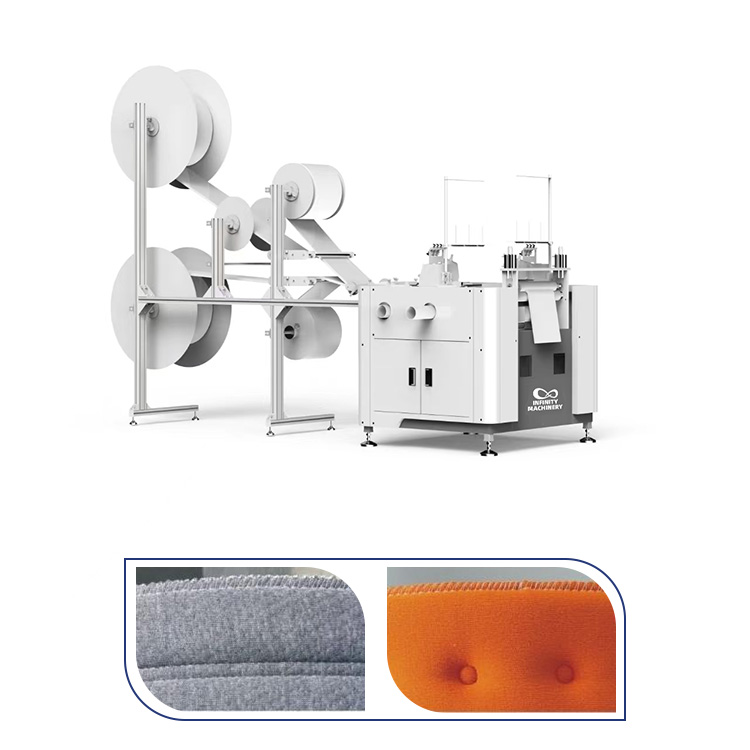
The daily capacity of the automatic tape edge line is the number that the owner asks for and the brochure rarely answers honestly: the machine nameplate says the maximum speed, and the maximum speed is not the daily output. The honest capacity is the cycle time math: the tape edge cycle per unit, the real shift hours after the breaks and the changeover, the downtime for the thread and the adjustment, and the operator factor that the line cannot ignore. The same line produces the different numbers for the different mattress sizes, the twin and the queen and the king, because the border length changes the cycle; and the capacity is the range, not the single number, from the small unit at the fast cycle to the large unit at the slow cycle. The IF-SBP90 Heavy Flanging Machine, the IF-SH4 Automatic Handle Belt Sewing Machine and the IF-SB-A2 Front and Back Double-heads Mattress Sewing Machine are the machine cases this guide maps. This guide walks the cycle time math, the real shift hours, the losses and the capacity table for the common mattress sizes.
The capacity question starts with the gap between the nameplate and the shift: the automatic tape edge machine is rated at the maximum speed, the fastest cycle on the ideal unit with the perfect setup, and the daily output is a different number. The daily capacity is what the line actually finishes in the shift, and the shift is not the machine time: the shift includes the start-up, the breaks, the changeover between the sizes, the thread changes, the adjustments and the small stops, and the real production time is the fraction of the shift. The capacity math is the honest calculation: the cycle time per unit times the number of units, plus the losses, and the result is the capacity range for the mattress sizes. The owner who asks the capacity question needs the honest range, not the brochure number, because the capacity decides the order acceptance, the line balance and the delivery promise. The factory that knows the honest capacity plans the orders that the line can finish, schedules the changeover and quotes the delivery that the line can meet, and the factory that quotes the nameplate speed overpromises and misses the delivery. The capacity is the planning number, and the planning number is the cycle math below.
The four inputs build the capacity, and the sections below turn them into the daily number.
The cycle time is the foundation of the capacity, and the cycle is driven by the border length. The tape edge machine sews the tape around the perimeter of the mattress, and the perimeter is the border length, the sum of the four sides; the twin mattress with the short perimeter sews the shorter distance and finishes faster, and the king mattress with the long perimeter sews the longer distance and takes the longer cycle. The cycle time math: the tape edge machine runs the sewing at the meters per minute, and the cycle is the border length divided by the sewing speed, plus the corner turns, the loading and the unloading. The typical cycle: the twin and the full mattress run the sixty to ninety second cycle, the queen runs the ninety to the one hundred twenty seconds and the king runs the one hundred twenty to the one hundred fifty seconds, depending on the machine speed and the operator. The cycle is the raw number, and the raw capacity is the shift seconds divided by the cycle: the eight hour shift has the twenty eight thousand eight hundred seconds, and the ninety second cycle gives the three hundred twenty raw units, before the losses. The cycle math is the first half of the capacity, and the losses are the second half.
Cycle = border length / sewing speed + corner turns + load/unload | Twin-full: 60-90s per unit | Queen: 90-120s | King: 120-150s | Raw capacity: 28,800 shift seconds / cycle time, e.g. 90s cycle = 320 raw units, before losses
The real shift hours are the production window after the losses, and the losses are the honest part of the capacity. The eight hour shift is not eight hours of sewing: the shift starts with the start-up, the machine check and the first setup, the operators take the breaks, the lunch stops the line and the shift end cleans the machine, and the production time is the shift minus the fixed losses. The fixed losses are the routine: the start-up and the check take the fifteen to twenty minutes, the breaks take the thirty to forty minutes across the shift and the clean-up takes the ten to fifteen minutes, and the fixed losses total the sixty to seventy five minutes, leaving the six and three quarters to seven hours of the production window. The variable losses add to the fixed: the changeover between the mattress sizes takes the fifteen to thirty minutes each, the thread changes and the needle changes take the minutes during the run, and the small stops, the jam and the adjustment, take the minutes here and there. The real utilization of the tape edge line runs in the seventy five to eighty five percent range on the good day, and the utilization is the number that converts the raw capacity into the daily output. The real shift hours are the honest window, and the factory that plans the window plans the capacity that the line can actually deliver.
The losses are the honest part of the capacity, and the real window is the number that the planning uses.
The operator factor is the human side of the capacity, and the automatic machine still needs the operator. The tape edge line runs with the operator at the loading and the unloading: the operator places the mattress on the machine, starts the cycle and removes the finished unit, and the loading time is part of the cycle that the machine cannot remove. The operator also runs the monitoring: the thread tension, the needle condition, the tape feed and the seam quality are watched during the run, and the small adjustment, the thread re-thread and the jam clear, stop the machine for the minutes. The changeover is the operator task: the size change adjusts the machine, the guides and the program, and the changeover time is the operator time between the runs. The operator factor is the capacity multiplier: the trained operator loads at the fast pace, catches the thread issue before the jam and changes over in the short time, and the trained operator adds the ten to fifteen percent to the daily output against the untrained operator. The operator factor is also the labor math: the automatic tape edge line runs one operator per machine, or one operator for two machines on the loading-buffer setup, and the labor per unit drops with the automation while the operator still matters for the output. The capacity is the machine and the operator together, and the factory that trains the operator gets the capacity that the machine can deliver.
The capacity table is the planning tool, and the table shows the honest range for the common mattress sizes. The table is built from the cycle time and the real shift window: the eight hour shift with the seventy five to eighty five percent utilization, the cycle per size and the operator factor. The twin and the full mattress: the sixty to ninety second cycle, the raw capacity of the three hundred twenty to two hundred twenty units, and the real capacity of the two hundred forty to one hundred eighty units per shift. The queen mattress: the ninety to one hundred twenty second cycle, the raw capacity of the two hundred twenty to one hundred sixty units, and the real capacity of the one hundred eighty to one hundred thirty units per shift. The king mattress: the one hundred twenty to one hundred fifty second cycle, the raw capacity of the one hundred sixty to one hundred thirty units, and the real capacity of the one hundred thirty to one hundred ten units per shift. The mixed line runs the weighted average: the factory that produces the mix of the twin, the queen and the king runs the capacity between the size numbers, and the weighted average is the planning number for the mixed orders. The table is the honest answer to the capacity question, and the factory that plans with the table promises the delivery that the line can meet.
The table is the planning range, and the factory that quotes the range instead of the single number sets the honest expectation.
The capacity plan uses the honest number to run the line, and the plan has the five steps. Step 1: the baseline, counting the finished units per shift for the month and the size mix, and computing the real capacity and the real utilization. Step 2: the loss log, tracking the changeover, the thread and the stop times for the week, and naming the biggest loss to attack. Step 3: the improvement, reducing the biggest loss, the changeover pre-set, the planned thread changes and the operator training, and re-measuring the utilization. Step 4: the schedule, planning the orders with the capacity table and the weighted average, and promising the delivery that the line can meet. Step 5: the re-measure, running the improved line for the month and comparing the capacity against the baseline; the rising finished count proves the improvement, and the honest number keeps the promise. The factory that runs the five steps knows the daily capacity, and the known capacity is the planning number that the orders, the delivery and the line balance all use.
The IF-SBP90, the IF-SH4 and the IF-SB-A2 cover the flanging, the handle and the double-head stops of the tape edge line, and the capacity plan turns the honest number into the running plan. Contact our border team for the capacity audit for your line, the loss-log template and the capacity table that plans your orders with the honest number.
Contact our border team today for the capacity audit of your tape edge line: the cycle time measurement, the loss log and the capacity table that give you the honest daily output for your order planning.