

As global labor costs continue to surge and profit margins face unprecedented pressure, mattress factory owners are seeking proven methods to optimize their operations. This comprehensive guide reveals five battle-tested strategies that top manufacturers are using to reduce operating costs by up to 40% while scaling production capacity.
The 2026 Manufacturing Reality Check: Why Traditional Cost-Cutting No Longer Works
The global mattress manufacturing landscape has undergone a fundamental transformation. What worked five years ago—incremental labor reductions and material tweaks—is now insufficient. In 2026, factory owners face a perfect storm of challenges: labor shortages, raw material price volatility, and increasingly demanding quality standards from major retailers.
At Infinity Machinery, our 15+ years of engineering experience working with mattress manufacturers across 30+ countries has revealed a critical insight: the factories thriving in 2026 aren't those cutting corners—they're those upgrading their operational DNA through smart automation. The distinction between surviving and thriving comes down to strategic technology adoption.
Strategy 1: Replace Labor-Intensive Tape Edging with Robotic Automation
The most significant cost center in mattress manufacturing has traditionally been the tape edging process. Manual tape edging requires 2-3 skilled workers per shift, represents 25-30% of total labor costs, and creates an artificial production bottleneck that limits daily throughput. Workers manually flip, rotate, and guide mattresses through the sewing machine—a process prone to fatigue-induced errors, inconsistency, and repetitive motion injuries.
Modern automated tape edging solutions eliminate this bottleneck by integrating robotic arms with precision PLC control systems. The Infinity Machinery IF-T4, for example, processes 18-20 mattresses per hour with minimal operator intervention, automatically slowing at turn positions to ensure consistent, high-quality stitching. This single-machine upgrade typically reduces labor requirements from 3 workers to 0.5 workers per shift—a direct 80% labor cost reduction in this department.
The ROI Mathematics: Breaking Down the Financial Impact
Let's calculate the concrete financial impact of automating mattress tape edging for a mid-sized factory producing 60 mattresses per day. Assuming average labor costs of $25/hour per worker, 2 shifts per 16-hour operating day, and 300 operating days per year:
- Current Annual Labor Cost (Manual): 3 workers × $25/hour × 16 hours × 300 days = $360,000/year
- Projected Annual Labor Cost (Automated): 0.5 workers × $25/hour × 16 hours × 300 days = $60,000/year
- Direct Annual Savings: $300,000/year
- Typical Equipment Investment: $45,000 - $65,000 (IF-T4 model)
- Payback Period: 2-3 months (assuming equipment investment of $60,000)
This analysis doesn't even account for the compounding benefits: increased daily throughput (typically 30-50% more units per shift), reduced worker's compensation claims, elimination of sewing defects that require rework, and the ability to redeploy skilled workers to higher-value tasks like quality assurance and production planning.
Strategy 2: Upgrade Quilting Capacity with High-Precision Multi-Needle Systems
Quilting represents both a quality-critical process and a significant throughput limitation. Traditional single-needle quilting machines operate at 70-120 meters per hour, creating a production ceiling that forces factories to either invest in multiple machines or accept longer lead times. Each additional machine requires additional floor space, electrical infrastructure, and operator supervision—expanding fixed costs and operational complexity.
The 2026 solution lies in computerized multi-needle quilting systems that achieve speeds of 200+ meters per hour while maintaining exceptional stitch quality through servo-driven precision. The Infinity Machinery IF-QS2-1 Automatic Computerized Single Needle Quilting Machine, for instance, integrates German DURKOPP sewing heads—industry-recognized for reliability and precision—with automatic thread break detection and 360° jump-stitch pattern capabilities.
By consolidating quilting capacity into fewer, higher-speed machines, factories achieve multiple compounding benefits: reduced machine maintenance overhead (fewer sewing heads to service), lower total power consumption (modern servo systems are 40-50% more energy-efficient than older motor-driven systems), and simplified production scheduling with fewer production lanes to coordinate.
Strategy 3: Implement Preventive Maintenance Protocols to Extend Equipment Lifespan
One of the most overlooked costs in mattress manufacturing is reactive equipment maintenance. When machines break down during production shifts, the costs cascade: unscheduled labor downtime, overtime to recover lost production, expedited parts shipping at premium rates, and potential damage to work-in-progress inventory. A single catastrophic failure can cost $10,000-$50,000 in combined direct and indirect costs—a significant portion of annual operating margin.
Leading factories have implemented Industry 4.0-compliant preventive maintenance systems that monitor equipment health in real-time and schedule maintenance during planned downtime periods. Key elements include:
- Daily Visual Inspections: Operators perform start-of-shift checks on sewing heads, belts, and pneumatic systems, identifying potential issues before they cause failures.
- Scheduled Component Replacement: Critical wear parts (needles, feed dogs, presser feet, belts) are replaced on fixed schedules based on actual operating hours, not failure-based replacement.
- Vibration and Temperature Monitoring: Modern sewing heads with integrated sensors alert operators to abnormal vibration patterns or temperature increases—early indicators of bearing or motor degradation.
- Lubrication Management Systems: Automated lubrication or scheduled manual lubrication ensures proper lubricant levels, reducing friction-related wear and extending component life by 40-60%.
Factories implementing comprehensive preventive maintenance typically reduce unplanned downtime by 70-80% and extend equipment lifespan from 5-7 years to 10-12 years—effectively halving equipment replacement costs over a 20-year planning horizon.
Strategy 4: Optimize Material Utilization Through Precision Cutting Systems
Material waste represents an invisible but substantial cost center. Manual cutting of foam, fabric, and border materials typically results in 8-15% waste due to imprecise cuts, inability to optimally nest patterns, and human error during measurement and cutting. For a factory processing $500,000 annually in foam and fabric materials, this translates to $40,000-$75,000 in pure waste cost—money that goes directly to the landfill.
Computerized cutting systems with optimized nesting algorithms reduce material waste to 3-5% by analyzing patterns and arranging them for maximum material utilization. Modern systems also incorporate knife compensation features that account for kerf (material removed during cutting), ensuring final dimensions meet specifications without requiring oversized cuts that create scrap.
The financial impact compounds across multiple dimensions: direct material cost savings, reduced waste disposal fees (which are rising globally), and the ability to quote more competitively on high-volume contracts because material overhead is predictable and minimized.
Strategy 5: Implement Factory Layout Optimization for Production Flow Efficiency
Factory layout might seem like a fixed cost, but inefficient layouts create ongoing operational costs through unnecessary material handling, worker movement, and work-in-process accumulation. Traditional factory layouts often organize departments by machine type (all quilting machines in one area, all tape edging machines in another), creating long travel distances for semi-finished products moving between production stages.
Modern Industry 4.0 factory layouts organize machines by production flow, minimizing travel distances and enabling cellular manufacturing where teams handle complete production sequences in contained areas. Benefits include reduced material handling labor (30-50% reduction in forklift and manual transport), reduced work-in-process inventory (materials move faster through production), and faster identification of production bottlenecks (clear visual flow makes blockages immediately apparent).
Infinity Machinery offers comprehensive factory layout consultation as part of our one-stop solutions approach, helping factory owners reorganize production lines for optimal flow without requiring complete facility rebuilds. Small strategic reconfigurations can yield 15-25% improvements in overall throughput without purchasing a single additional machine.
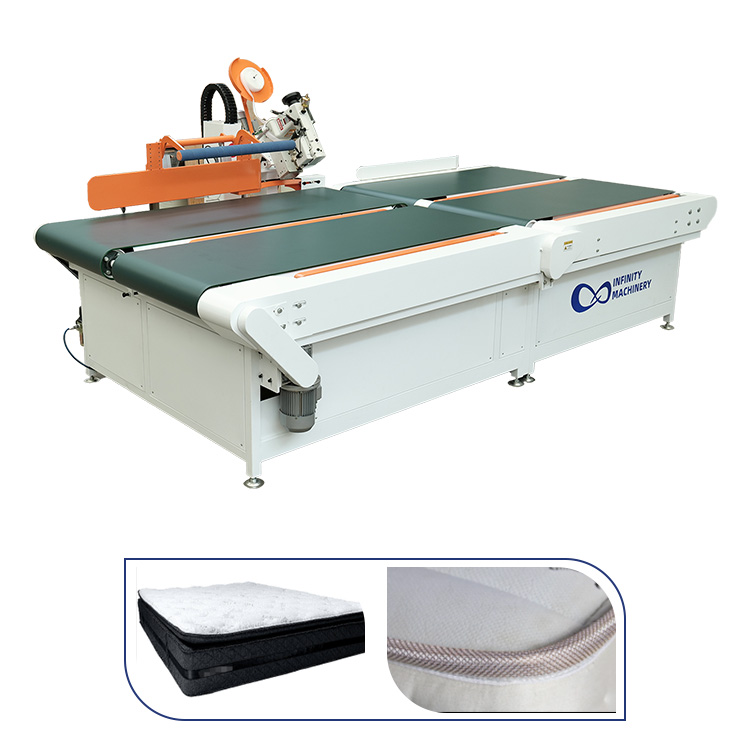

Technical Specifications: Cost-Optimization Machines
* Technical parameters are subject to customization. Contact us for factory-specific configurations.
Maintenance Guidelines: Maximizing Your Automation Investment
Purchasing automated equipment is only the first step. To realize the full ROI potential, factories must implement comprehensive maintenance protocols that extend equipment aselife and prevent costly production interruptions. At Infinity Machinery, we recommend a tiered maintenance approach:
Daily Maintenance (Shift Start/End - 15 minutes)
- Visual Inspection: Check for loose bolts, damaged wiring, or visible wear on moving components
- Air System Check: Verify air compressor pressure (typically 6-8 bar) and check for air leaks in pneumatic lines
- Lubrication Points: Apply specified lubricants to designated points according to manufacturer schedules
- Cleaning: Remove fabric debris, dust accumulation, and thread waste from sewing heads and cutting areas
- Test Cycle: Perform a test run with a sample mattress to verify stitch quality and machine operation
Weekly Maintenance (Planned Downtime - 1 hour)
- Belt Inspection: Check drive belts for cracking, fraying, or improper tension
- Electrical Connections: Inspect terminal blocks and control cabinets for loose connections or oxidation
- Sensor Calibration: Verify optical sensors and proximity switches are correctly positioned and functioning
- Filter Replacement: Replace air filters in pneumatic systems and dust collection units
- Backup Critical Data: Backup PLC programs and custom stitch patterns to secure external storage
Monthly Maintenance (Planned Downtime - 2-3 hours)
- Sewing Head Overhaul: Remove sewing heads, clean internal mechanisms, and replace worn components (hooks, take-up levers, needle bars)
- Bearing Inspection: Check all rotating assemblies for abnormal play, noise, or temperature during operation
- Electrical System Testing: Use thermal imaging to identify hotspots in electrical panels and motor windings
- Software Update: Update firmware and PLC software to latest manufacturer versions for bug fixes and performance improvements
Factories implementing this tiered maintenance approach typically experience 80-90% reduction in unplanned downtime and extend equipment lifespan from 5-7 years to 10-15 years—effectively doubling equipment ROI over the ownership period.
Common Pitfalls to Avoid: Lessons from Factory Implementations
Through hundreds of factory implementations, Infinity Machinery has identified recurring pitfalls that undermine automation investments. Avoiding these mistakes is as important as selecting the right equipment:
Pitfall 1: Insufficient Operator Training
Automated machines represent a significant upgrade from manual equipment, requiring operators to develop new skill sets around PLC interfaces, program parameter adjustment, and advanced troubleshooting. Factories that purchase equipment without investing in comprehensive operator training typically experience longer adoption periods (3-6 months instead of 1-2 months), higher defect rates during transition, and underutilization of advanced features.
Solution: Infinity Machinery provides comprehensive operator training as standard with equipment purchase, including hands-on sessions, detailed operation manuals, and remote consultation during the initial implementation period. Budget for 2-3 days of dedicated training time per operator group to ensure full capability utilization.
Pitfall 2: Underestimating Infrastructure Requirements
Modern automated equipment has specific infrastructure requirements that older manual machines do not. Inadequate air compressor capacity, unstable electrical power, or insufficient floor space can prevent equipment from operating at rated specifications. A factory installing an automated tape edging machine without sufficient air capacity may experience intermittent pressure drops that cause stitching defects or machine stoppages.
Solution: During the equipment selection phase, request detailed infrastructure requirements (air consumption, power load, floor space dimensions, environmental conditions) and verify existing factory infrastructure meets or exceeds specifications before purchase. Infinity Machinery provides infrastructure audit services to identify and address gaps prior to installation.
Pitfall 3: Ignoring Production Flow Integration
Even the most capable equipment creates value only when integrated effectively into production flow. Installing a high-speed tape edging machine at the end of a production line with bottlenecks earlier in the process (e.g., slow manual quilting) creates artificial accumulation and limits throughput gains. The investment in automated tape edging doesn't deliver ROI if the machine sits idle waiting for input from upstream processes.
Solution: Approach automation upgrades holistically rather than as isolated machine purchases. Infinity Machinery's one-stop solutions philosophy evaluates the entire production line and recommends equipment upgrades in sequence that creates balanced capacity across all production stages, maximizing overall throughput improvements.
Pitfall 4: Purchasing Based Solely on Initial Price
The mattress machinery market includes equipment options at widely varying price points. Equipment with significantly lower initial price often uses inferior components (generic sewing heads instead of German DURKOPP, standard motors instead of servo systems, lighter gauge steel construction) that result in higher long-term costs through frequent repairs, shorter equipment life, and suboptimal performance quality.
Solution: Evaluate equipment on total cost of ownership (TCO) rather than initial purchase price. Consider: expected equipment lifespan (quality machines last 10-15 years, budget machines 3-5 years), maintenance costs (quality machines require less frequent repairs), energy efficiency (servo systems save 40-50% on power), and performance consistency (quality machines maintain specifications over their life, budget machines degrade faster).
Factory Layout Integration: Seamless Equipment Deployment
Successful automation extends beyond individual machine performance to how equipment integrates into overall factory layout. Infinity Machinery provides comprehensive layout consultation services as part of our one-stop solutions approach, ensuring new equipment creates value through optimized production flow:
Cellular Manufacturing Arrangement
Modern factory layouts organize equipment into production cells where complete mattress production sequences occur in contained areas. Rather than organizing all quilting machines together and all tape edging machines together, cellular layouts place complementary machines in proximity (quilting machine adjacent to tape edging machine adjacent to packing station), minimizing material movement and enabling smaller teams to handle complete production workflows.
Benefits include: reduced material handling labor (30-50% reduction), reduced work-in-process inventory accumulation (faster throughput), faster identification and resolution of production issues (clear visual flow), and improved worker engagement (teams see completed products rather than isolated tasks).
Automated Material Flow Systems
Advanced factory implementations incorporate automated material transport systems (conveyors, roller tables, robotic transfer systems) that move semi-finished products between production stages without manual intervention. While these systems represent additional capital investment, they deliver compounding ROI through:
- Consistent Production Pace: Automated transfer prevents equipment idle time waiting for manual material movement
- Reduced Product Damage: Automated systems handle products with consistent pressure and orientation, reducing edge compression and surface marring
- Production Tracking: Automated transfer points integrate with barcode/RFID tracking systems for real-time production monitoring and quality traceability
- Labor Redeployment: Workers formerly dedicated to material transport move to higher-value tasks like quality assurance and machine operation
Flexibility for Model Changeovers
Mattress factories producing multiple models require layouts that support efficient changeovers between different mattress sizes, thicknesses, and configurations. Layout considerations include: standardized working heights across production stations (prevent strain during model transitions), clear floor marking for different model workflows (prevent confusion and cross-contamination), and strategic positioning of adjustment-accessible equipment (minimize changeover downtime).
Infinity Machinery's equipment is designed specifically for rapid changeover with features like: quick-release clamping systems, memory-stored parameter settings for different models, and standardized adjustment points accessible without specialized tools. This flexibility enables factories to maintain high throughput even with mixed-model production schedules.
Frequently Asked Questions: Cost Reduction & Automation
What is the typical ROI period for automating mattress tape edging?
The typical ROI period for automated tape edging is 2-3 months based on labor cost reductions alone. For a factory producing 60 mattresses per day with 3 workers per shift at $25/hour, annual labor savings of $300,000 easily offset the equipment investment of $45,000-$65,000. When including compounding benefits like increased throughput (30-50% more units), reduced rework costs, and worker's compensation reduction, the effective ROI period can be as short as 6-8 weeks. This makes automated tape edging one of the highest-return investments available to mattress manufacturers.
How much labor can I realistically save with automated quilting machines?
Automated quilting machines typically reduce labor requirements by 40-100% depending on your current setup. A factory using multiple manual quilting machines can often consolidate into fewer high-speed automated machines, reducing from 1 operator per machine to 0.5 operators overseeing multiple machines. More significantly, automated quilting increases throughput by 50-80% at equivalent labor levels, enabling the same team to produce significantly more output. The IF-QS2-1, for example, operates at 70-200m/hour with automatic thread break detection, requiring only operator oversight rather than constant manual intervention. This enables factories to scale production capacity without proportional labor cost increases.
What infrastructure requirements do I need to consider before purchasing automated equipment?
Key infrastructure requirements include: 1) Air supply - Most automated machines require compressed air at 6-8 bar with sufficient flow capacity (consult manufacturer specifications). 2) Electrical power - Verify available voltage, amperage, and phase compatibility. Modern servo-driven machines may require 3-phase power. 3) Floor load capacity - Automated machines are heavier than manual equipment (IF-T4 weighs 1600KG). 4) Environmental conditions - Temperature and humidity control affects machine performance and thread consistency. 5) Floor space - Include clearance for operator access, maintenance, and material flow. Infinity Machinery provides detailed infrastructure requirements with each equipment specification and offers pre-purchase infrastructure audits to identify and address gaps before installation.
How long does it typically take to implement automation in an existing factory?
Implementation timeline varies by scope but generally follows this pattern: 1) Planning and specification (2-4 weeks) - infrastructure audit, equipment selection, and layout planning. 2) Equipment procurement and preparation (4-8 weeks) - manufacturing, shipping, and pre-installation preparation. 3) Installation and commissioning (1-2 weeks) - physical installation, electrical and air connection, and initial testing. 4) Operator training (1-2 weeks) - hands-on training, practice sessions, and competency verification. 5) Production ramp-up (2-4 weeks) - gradual increase to full production volume with performance tuning. Total implementation from decision to full production typically ranges 10-20 weeks. Infinity Machinery supports the entire process with remote consultation, installation supervision, and ongoing technical support to minimize disruption to existing operations.
What maintenance training does Infinity Machinery provide with equipment purchase?
Infinity Machinery provides comprehensive maintenance training as standard with every equipment purchase. Training includes: 1) Daily maintenance procedures - 15-minute start/end of shift routines for optimal equipment health. 2) Weekly maintenance protocols - periodic inspections and adjustments during planned downtime. 3) Monthly maintenance schedules - component replacement and system calibration. 4) Troubleshooting methodology - systematic approaches to identifying and resolving common issues. 5) Emergency response procedures - immediate actions for equipment failures to minimize damage and downtime. Training is delivered through hands-on sessions with the actual equipment, detailed maintenance manuals with photos and diagrams, and ongoing remote consultation during the initial implementation period. This comprehensive approach ensures factories can maintain equipment effectively without depending on external service providers for routine maintenance.
Can I automate gradually or do I need to upgrade my entire production line at once?
Gradual automation is not only possible but recommended for most factories. Rather than replacing the entire production line simultaneously, Infinity Machinery recommends a phased approach starting with the most labor-intensive or bottlenecked processes. Common starting points include tape edging (highest labor reduction ROI), quilting (highest throughput improvement), or packaging (often completely manual). Each phase delivers immediate ROI that funds subsequent upgrades. This staged approach minimizes capital disruption, allows operators to adapt to new technology progressively, and enables performance optimization at each stage before proceeding to the next. Infinity Machinery's one-stop solutions philosophy includes multi-phase implementation roadmaps that identify optimal upgrade sequences based on each factory's specific production profile and financial constraints.
Start Cutting Your Operating Costs Today: Get Your Custom Automation ROI Analysis
Every day without automation costs your factory $500-$1,500 in unnecessary labor and material waste. Our engineering team will analyze your current production processes and create a custom cost-reduction roadmap with projected ROI timelines. Most factories recover their full investment within 3-6 months through direct labor savings alone.
Trusted by 1000+ Mattress Factories Worldwide | Industry 4.0 Standard


