

1. The Production Bottleneck of Manual Tape Edging
Production BottleneckManual tape edge operations require skilled operators to physically guide, lift, and rotate heavy mattresses through standard sewing heads. This manual intervention introduces severe physical fatigue, irregular cycle times, and an unreliable daily output that strictly limits overall factory scaling and delivery timelines.
Operational Friction
- Human Fatigue Factor: Manual guiding of thick, multi-layer mattresses causes velocity drops during cornering, stalling the continuous workflow.
- Technical Solution: Modern automated machinery utilizes integrated conveyor systems and robotic assistance to maintain steady feed rates without human exertion.
2. Analyzing Hourly Output and Throughput Deficits
Throughput AnalysisTraditional semi-automatic or manual setups typically yield a meager 10 to 15 beds per hour, heavily constrained by operator endurance and frequent resting intervals. In contrast, fully automated lines scale production dramatically, meeting the aggressive volume demands of modern industrial Mattress Manufacturing One-Stop Solutions.
Output Metrics
- Cycle Time Disparity: Manual flipping and cornering consume up to 40% of total active operational time per individual mattress unit.
- Technical Solution: Servo-driven automatic turning and 90° deceleration eliminate dead time between sides, elevating output velocity to over 25 units per hour.
3. The True Labor Cost Burden of Legacy Tape Edge Operations
Labor DynamicsRelying on veteran sewing operators introduces heavy wage dependencies and extreme vulnerability to high employee turnover in the manufacturing sector. When experienced personnel are scarce, manual workstations stand idle, directly eroding plant profitability and delaying critical commercial shipments.
Workforce Economics
- Skill Scarcity Impact: Finding, training, and retaining specialized tape edge operators incurs steep training costs and continuous wage premiums.
- Technical Solution: Programmable PLC controls and artificial intelligence operation allow semi-skilled personnel to oversee multiple automated stations simultaneously.
4. Mechanical Precision and Seam Consistency
Sewing PrecisionManual tape edging frequently suffers from uneven borders, wavy stitches, and corner bunching due to inconsistent manual tension and hand-guided steering. Automated systems utilize synchronized mechanical guides and digital tensioners to ensure flawless, straight seams on every single bed.
Quality Control
- Corner Bunching Risk: Manual deceleration during corners frequently leads to thread breakage, skipped stitches, and unacceptable fabric puckering.
- Technical Solution: Automated speed-reduction algorithms and robotic clamping secure perfect corner radiuses without requiring operator intervention.
Essential Machinery for Scaling Production
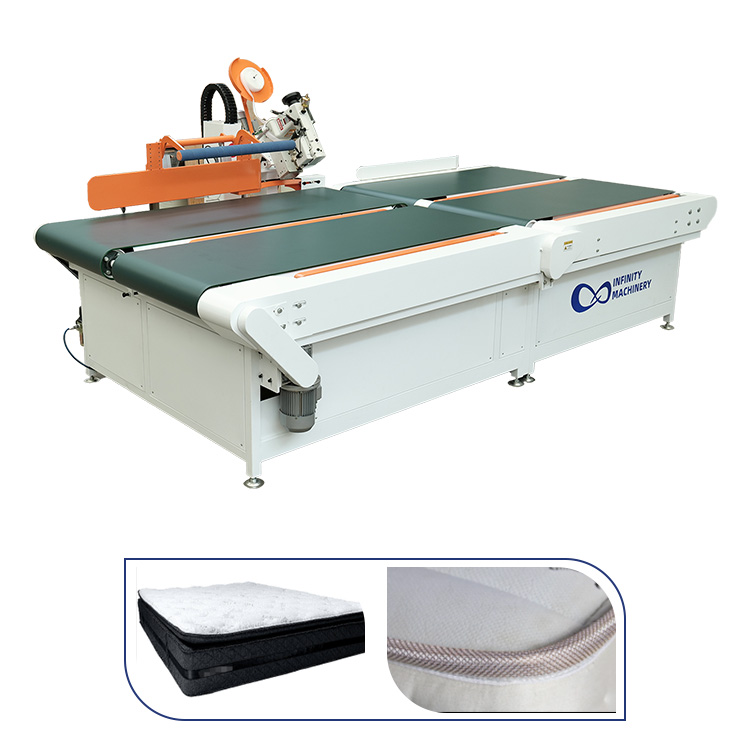
Fully automatic high-speed tape edge machine featuring a robotic arm, automatic 90° turning, and PLC control to eliminate labor intensity and maximize output.

Ergonomic tape edge system equipped with an advanced servo mechanism for precise sewing, automatic flipping, and stable high-speed performance.
5. Reduction of Physical Strain and Operator Dependency
Ergonomic EngineeringGuiding heavy mattresses weighing over 50 kilograms causes severe cumulative trauma disorders among factory workers and high absenteeism. Upgrading to systems with built-in compression and turning devices dramatically improves workplace safety while maintaining maximum production velocity.
Workplace Safety
- Ergonomic Hazards: Lifting and pivoting heavy units manually increases worker compensation claims, fatigue, and injury risks.
- Technical Solution: Patented lifting tables and automated flipping mechanisms handle heavy lifting safely and continuously across shifts.
6. Calculating Return on Investment and Cost-Per-Bed Metrics
Financial EvaluationEvaluating machinery upgrades requires a clear financial comparison between total cost of ownership and ongoing labor savings. By cutting labor requirements per station in half and doubling hourly output, automated tape edge systems typically achieve full capital payback within 12 to 18 months.
Capital Allocation
- Cost-Per-Bed Reduction: Lower labor overhead combined with zero-defect production directly drives down manufacturing costs per unit.
- Technical Solution: High-throughput automation maximizes factory utilization rates, accelerating return on plant infrastructure investments.
7. Maintenance Simplicity and Long-Term Machine Reliability
Equipment MaintenanceIndustrial manufacturing machinery must deliver dependable, round-the-clock operation with minimal unexpected downtime. Advanced automated systems incorporate robust structural frames, automated lubrication, and easily accessible modular components for swift routine maintenance.
Operational Reliability
- Downtime Vulnerability: Worn mechanical linkages and unlubricated components cause unexpected halts in legacy manual equipment.
- Technical Solution: Premium linear guides, brushless servo motors, and centralized oil supply minimize mechanical wear and simplify service intervals.
Strategic Manufacturing Takeaway
Replacing slow, labor-intensive manual tape edge operations with automated, reliable equipment like Infinity Mattress Machinery is the definitive strategy for reducing cost-per-bed, maximizing output per shift, and securing long-term factory profitability.
Ready to Upgrade Your Factory Line?
Contact our engineering specialists today for customized layout designs and high-efficiency machinery quotations.

