

1. Diagnosing Root Causes of Upper and Lower Thread Breakage
Diagnostic StepUnplanned machine stops resulting from snapped threads stem from excessive needle heat, incorrect tension disk calibration, or burrs on the hook point. Technicians must first isolate whether the failure occurs on the needle thread or bobbin supply.
Diagnostic Factor: Tension and Friction Points
- Material Friction: High-speed multi-needle quilting generates intense friction points across ceramic eyelets and tension springs, causing localized thread fraying.
- Technical Solution: Inspect and polish ceramic guides regularly, and ensure needle cooling systems and silicone lubrication pots are active during heavy-duty runs.
2. Calibrating Rotary Hook-to-Needle Timing and Clearance
Mechanical CalibrationTiming drift occurs when continuous mechanical vibration alters the synchronized relationship between the needle bar descent and the rotary hook point traversal, resulting in skipped stitches and needle strikes.
Engineering Analysis: Synchronized Tolerances
- Rotary Clearance: The gap between the needle scarf and the hook point must be maintained strictly between 0.05mm and 0.1mm to ensure reliable loop pick-up without collision.
- Technical Solution: Utilize precision feeler gauges to reset the hook timing bracket, locking down the servo-driven main shaft couplings to eliminate mechanical slippage.
3. Mitigating Mechanical Wear and Tension Misalignment in Sewing Heads
Component WearAged sewing heads suffer from slack linkages, worn gear teeth, and degraded bushing tolerances. These physical gaps accumulate play, directly causing erratic thread pickup and inconsistent stitch formation across thick quilting panels.
Mechanical Property: Linkage Play & Backlash
- Drive Train Tolerances: Accumulated backlash in push rods and crank arms destabilizes needle bar dwell time at high RPM thresholds.
- Technical Solution: Replace worn pins and bushings immediately, and upgrade to direct-drive servo configurations that eliminate mechanical lag.
4. Infrared Thread Break Sensor Maintenance and Electrical Diagnostics
Electrical DiagnosticsModern automated quilting machines rely on sensitive optical or infrared sensors to instantly halt operations upon thread rupture. Dust accumulation and lens obstruction can trigger false positives or fail to stop the machine, risking material damage.
Operational Parameter: Optical Signal Integrity
- Sensor Contamination: Lint and airborne micro-fibers coat infrared emitters and receivers, reducing signal transmission clarity and causing erratic controller behavior.
- Technical Solution: Implement a weekly compressed-air cleaning protocol for all sensor arrays and calibrate voltage thresholds via the main PLC interface.
Essential Machinery for Scaling Production

Features a German DURKOPP head and automatic thread break detection, supporting complex 360° jump-stitch and custom patterns for stable production.
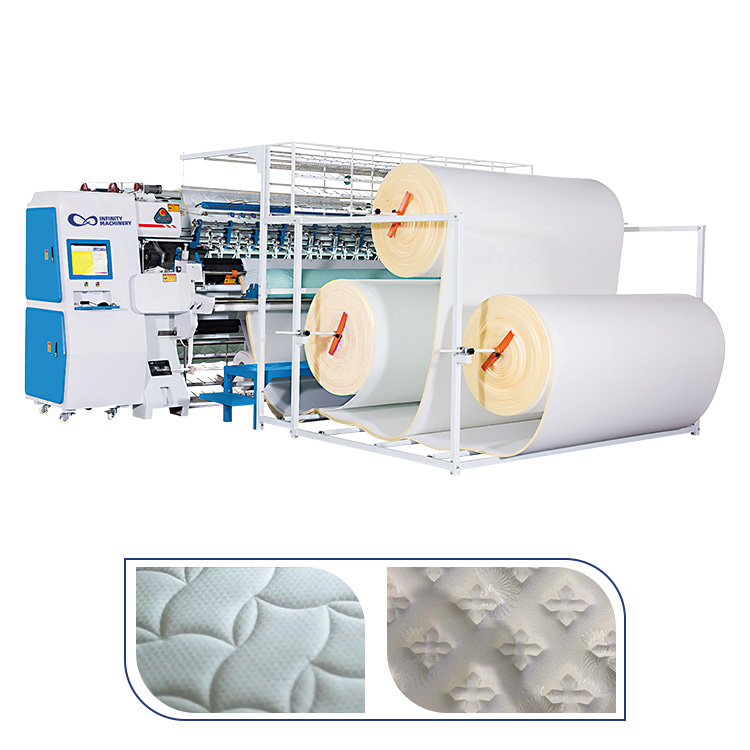
High-volume multi-needle quilting machine featuring servo-driven rollers, new shuttle guide rail, and advanced infrared thread break detection.
5. Lubrication Schedules and Friction Reduction for Extended Component Life
Maintenance ScheduleInadequate lubrication accelerates thermal expansion and metal-on-metal wear within high-speed rotary hooks and shuttle raceways, directly precipitating thread shredding and catastrophic mechanical seizure.
Maintenance Protocol: Viscosity & Flow Rate
- Lubrication Depletion: Running high-speed sewing heads without verified oil delivery leads to micro-scoring on hook races and increased needle temperatures.
- Technical Solution: Adhere strictly to automated oil pump flow checks and utilize high-grade synthetic machine oils specified for high-RPM textile equipment.
6. Servo-Driven Axis Calibration and Positioning Accuracy
Axis CalibrationMulti-axis quilting systems depend on precise synchronization between the saddle, roller, and sewing head motors. Encoder drift or motor coupling looseness causes pattern distortion and tension irregularities along sewing paths.
Control Parameter: Encoder Feedback & Home Position
- Positioning Drift: Minor slippage in belt drives or encoder pulse counting errors result in cumulative pattern misalignment over multi-panel runs.
- Technical Solution: Perform routine zero-point resetting, inspect timing belt tensioners, and recalibrate servo drive parameters through the control console.
7. Evaluating Replacement Thresholds: When Worn Components Cost More Than New Equipment
Replacement StrategyContinuously repairing fatigued mechanical assemblies eventually yields diminishing returns. Plant managers must analyze cumulative downtime losses against the cost of acquiring updated modular spare parts or modern machinery.
Economic Factor: Downtime Cost vs. Upgrade Value
- Repair Fatigue: Repeatedly machining worn housing bores and replacing obsolete drive shafts often costs more in lost shift productivity than full component renewal.
- Technical Solution: Standardize a replacement threshold matrix where major assemblies exceeding five years of heavy-duty cycles are systematically replaced or upgraded.
Engineering Takeaway for Plant Operators
Eliminating thread breakage and timing drift is vital for achieving high OEE (Overall Equipment Effectiveness) in modern bedding plants. By pairing rigorous preventive maintenance protocols with advanced, precision-engineered machinery from Infinity Mattress Machinery, factory owners can drastically cut material scrap, eliminate costly manual interventions, and secure long-term manufacturing profitability.
Ready to Upgrade Your Factory Efficiency?
Contact our engineering experts today for custom production line layouts and immediate technical support.


