

Single vs. Multi-Needle Mattress Quilting Machines: The Complete Selection Guide
Choosing between single and multi-needle mattress quilting machines can make or break your production ROI. After 15+ years engineering 300+ factory installations, we reveal which technology truly fits your operation.
In the competitive mattress manufacturing industry, quilting quality directly determines market positioning. Yet factory owners face a critical dilemma: should you invest in a single needle mattress quilting machine for precision flexibility, or a multi-needle mattress quilting machine for high-volume throughput?
At Infinity Machinery, we've witnessed countless manufacturers make costly mistakes by choosing the wrong technology. A hotel bedding supplier purchased a multi-needle machine only to discover it couldn't handle their custom luxury patterns. Meanwhile, a budget mattress startup invested in single needle equipment and struggled to meet 500-unit daily orders.
This comprehensive guide eliminates guesswork. We'll dissect the engineering differences, calculate real ROI scenarios, and provide a decision framework used by production managers across 40+ countries.
Single Needle vs. Multi-Needle Quilting: The Engineering Fundamentals
How Single Needle Mattress Quilting Machines Operate
A single needle quilting machine uses one sewing head mounted on a multi-axis carriage system. The fabric remains stationary while the needle head moves in X-Y coordinates, creating intricate patterns through programmed trajectories.
Our IF-QS2-1 Automatic Computerized Single Needle Quilting Machine exemplifies this architecture. Equipped with a German DURKOPP sewing head rotating at 3000rpm, it achieves quilting widths up to 2400mm with production speeds between 70-200m/h.
The key advantage lies in pattern versatility. Single needle systems excel at complex designs requiring 360° jump-stitch capabilities—essential for luxury mattress collections with decorative border quilting or custom logo integration.
How Multi-Needle Mattress Quilting Machines Operate
A multi-needle quilting machine employs multiple needles (typically 11-23 needles) arranged in a fixed horizontal bar. The fabric feeds continuously beneath the needle bar while all needles stitch simultaneously in parallel rows.
The IF-Q-1200 Computerized Chain Stitch Multi-Needle Quilting Machine demonstrates this approach. With a 2450mm quilting width and speeds reaching 260m/h, it's engineered for uninterrupted mass production handling materials up to 80mm thickness.
Multi-needle technology shines in continuous pattern repetition. Once the machine is threaded and programmed, it produces identical quilt panels with minimal operator intervention—ideal for standardized hotel contracts or retail mattress lines.
Production Speed & Throughput: Which Machine Wins?
Throughput analysis reveals nuanced truths that spec sheets often obscure. Let's examine real-world scenarios from our installed base.
Single Needle Throughput Reality
The IF-QS2-1's 70-200m/h speed range depends heavily on pattern complexity. Simple diamond patterns approach the 200m/h ceiling, while intricate floral designs with frequent direction changes may drop to 70-90m/h.
- Setup time: 15-20 minutes per pattern change
- Operator requirement: 1 skilled technician per machine
- Best batch size: 50-500 units before pattern rotation
For manufacturers running high-mix, low-volume production—think custom mattress boutiques or contract manufacturers serving multiple brands—single needle flexibility outweighs raw speed.
Multi-Needle Throughput Reality
The IF-Q-1200's 60-260m/h range reflects material handling more than pattern complexity. Since all needles fire simultaneously, pattern intricacy has minimal impact on speed.
- Setup time: 45-60 minutes for initial threading and tension calibration
- Operator requirement: 1 operator can manage 2-3 machines
- Best batch size: 1000+ units for optimal ROI
Multi-needle systems dominate when you're producing standardized panels for weeks without changeover. The infrared thread break detection on the IF-Q-1200 automatically stops the machine when issues occur, minimizing fabric waste during extended runs.
Featured Machines: Infinity's Quilting Solutions

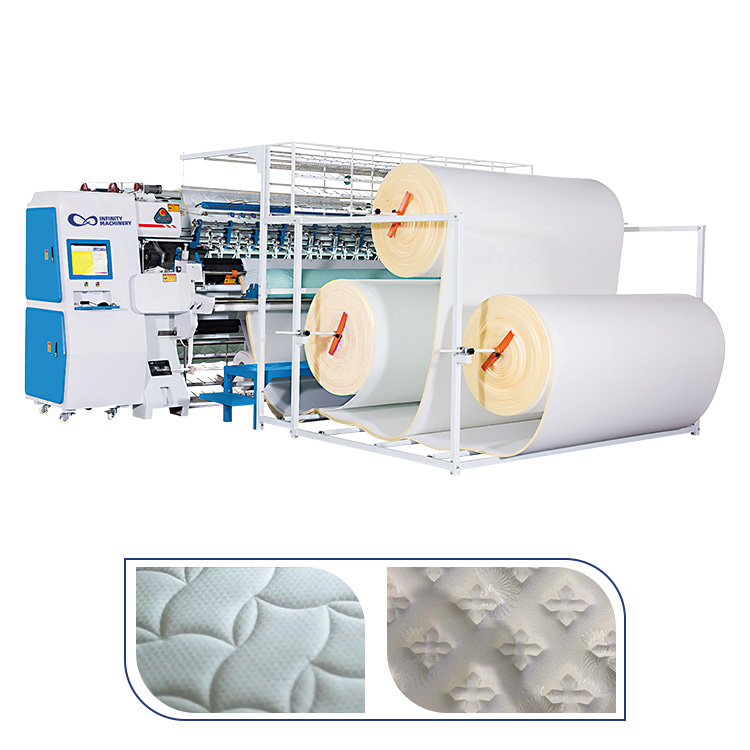
Head-to-Head Technical Specifications
IF-QS2-1 vs. IF-Q-1200: Specification Comparison
* Technical parameters are subject to customization. Contact us for factory-specific configurations.
ROI Calculation: The Real Cost of Your Decision
Equipment investment decisions must extend beyond purchase price. Let's calculate total cost of ownership across a 5-year operational horizon.
Single Needle ROI Scenario (IF-QS2-1)
Baseline: A mid-sized mattress factory producing 200 custom units daily across 8 product lines.
- Annual labor cost: $45,000 per skilled operator (1 machine = 1 operator)
- Pattern changeover downtime: 20 minutes × 3 changes/day × 250 days = 250 hours/year
- Revenue impact: High-mix capability commands 15-25% premium pricing
- Payback period: 18-24 months for custom/boutique operations
The IF-QS2-1's German DURKOPP sewing head typically requires minimal maintenance over 5 years. Expected needle replacement: every 50,000 stitches; full service interval: 2000 operating hours.
Multi-Needle ROI Scenario (IF-Q-1200)
Baseline: A contract manufacturer producing 800 standardized hotel mattress panels daily.
- Annual labor cost: $45,000 per operator (1 operator manages 2-3 machines)
- Setup amortization: 60 minutes initial setup spread across 10,000+ units = negligible per-unit cost
- Throughput advantage: 30-40% higher output vs. single needle for identical patterns
- Payback period: 12-18 months for high-volume standardized production
The IF-Q-1200's infrared thread break detection prevents costly fabric waste. In our installed base, this feature alone saves an average of $8,000-12,000 annually in material loss prevention.
Maintenance Requirements & Expected Lifespan
Proper maintenance directly impacts machine longevity and quilting quality consistency. Here's what factory managers need to know.
Single Needle Maintenance Protocol
- Daily: Clean needle area, check thread tension, verify sensor calibration
- Weekly: Lubricate X-Y carriage rails, inspect belt tension
- Monthly: Full sewing head service, motor brush inspection
- Expected lifespan: 10-12 years with proper maintenance
The IF-QS2-1's modular design allows component-level replacement. German DURKOPP heads maintain precision within 0.1mm tolerance even after 5+ years of operation.
Multi-Needle Maintenance Protocol
- Daily: Verify all needle positions, check infrared sensors, clean fabric feed rollers
- Weekly: Tension calibration across all needles, servo motor inspection
- Monthly: Complete thread path cleaning, chain stitch mechanism service
- Expected lifespan: 12-15 years with proper maintenance
Multi-needle machines benefit from simpler mechanical architecture—fewer moving axes means fewer wear points. However, needle bar alignment requires specialized technician training.
Common Pitfalls: What Competitors Don't Tell You
After servicing 300+ factory installations, we've identified recurring mistakes that cost manufacturers dearly.
Pitfall #1: Underestimating Pattern Changeover Impact
Manufacturers transitioning from manual to automated single needle quilting often underestimate the learning curve. Our data shows 3-4 weeks for operators to achieve optimal pattern changeover speed. During this period, expect 30-40% longer setup times.
Infinity Solution: We provide comprehensive operator training with every IF-QS2-1 installation, including pattern library setup and quick-change protocols.
Pitfall #2: Multi-Needle Thread Tension Drift
Budget multi-needle machines suffer from tension drift across the needle bar after 6-12 months. This causes inconsistent stitch quality—some rows tight, others loose—requiring costly rework.
Infinity Solution: The IF-Q-1200 features individual tension adjustment per needle position with locking mechanisms that maintain calibration for 1000+ operating hours.
Pitfall #3: Ignoring Fabric Feed System Compatibility
Multi-needle machines require consistent fabric tension across the full width. Inferior feed systems cause fabric creep, resulting in misaligned patterns at the edges. This defect often appears only after 500+ units, making root cause analysis difficult.
Infinity Solution: The IF-Q-1200's servo-driven roller/saddle system maintains ±0.5mm registration accuracy across the full 2450mm width, even at maximum speed.
Factory Layout Integration: One-Stop Solutions
Your quilting machine doesn't operate in isolation. It must integrate seamlessly with upstream material handling and downstream assembly processes.
Single Needle Integration Considerations
The IF-QS2-1's compact footprint (approximately 3.5m × 2.8m) fits easily into existing production cells. Its computerized controls support Industry 4.0 connectivity, enabling integration with MES (Manufacturing Execution Systems) for real-time production tracking.
For manufacturers running mixed-model assembly lines, single needle machines can be positioned as flexible "buffer stations" that handle custom orders without disrupting the main production flow.
Multi-Needle Integration Considerations
The IF-Q-1200 requires dedicated space allocation (approximately 5m × 3.5m) plus material staging areas for continuous fabric rolls. We recommend positioning multi-needle machines as the primary feed source for automated mattress assembly lines.
Infinity Machinery provides complete line design services, including conveyor integration, automated fabric unwinding systems, and quilted panel stacking solutions (such as our IF-QFS Automatic Quilted Fabric Stacking Machine) for seamless downstream handoff.
Decision Framework: Which Machine Fits Your Operation?
Use this checklist to determine your optimal quilting technology investment.
Choose Single Needle (IF-QS2-1) If:
- You produce 50-500 units per batch with frequent pattern changes
- Your product line includes custom or luxury designs requiring complex stitch patterns
- You serve multiple brands with different quilting specifications
- Your facility prioritizes flexibility over maximum throughput
- You need 360° jump-stitch capability for decorative borders or logo integration
Choose Multi-Needle (IF-Q-1200) If:
- You produce 1000+ units per batch with minimal pattern variation
- Your primary market is standardized hotel or retail mattresses
- You operate continuous shift production (2-3 shifts daily)
- Your facility prioritizes throughput efficiency over pattern versatility
- You need to quilt thick materials (up to 80mm) consistently
Frequently Asked Questions: Single vs. Multi-Needle Quilting
Can a single needle machine handle the same thickness as a multi-needle machine?
Generally, multi-needle machines handle thicker materials better. The IF-QS2-1 supports up to 50mm thickness, while the IF-Q-1200 handles up to 80mm. This is because multi-needle machines use continuous fabric feed with distributed pressure across the full width, whereas single needle machines rely on localized presser foot pressure.
How long does it take to train operators on these machines?
For single needle machines (IF-QS2-1), expect 2-3 weeks for basic operation proficiency and 3-4 weeks for optimal pattern changeover speed. Multi-needle machines (IF-Q-1200) require 4-6 weeks due to thread tension calibration complexity. Infinity Machinery provides comprehensive on-site training with every installation.
Is it better to buy one of each type for a new factory?
For new factories uncertain about market demand, a hybrid approach can be strategic. Start with one single needle machine (IF-QS2-1) for flexibility during product development and market testing. Once you identify your best-selling patterns and volumes, add a multi-needle machine (IF-Q-1200) for high-volume production. This phased investment minimizes risk while building operational expertise.
What is the typical warranty coverage for these machines?
Infinity Machinery provides a comprehensive 2-year warranty covering all major components including sewing heads, servo motors, and control systems. Extended warranty packages are available. The German DURKOPP sewing head on the IF-QS2-1 carries its own manufacturer warranty, and we maintain spare parts inventory for 10+ years post-purchase.
Ready to Optimize Your Mattress Quilting Production?
Whether you need the flexibility of single needle quilting or the throughput of multi-needle production, Infinity Machinery's 15+ years of engineering expertise ensures you get the right machine for your factory. Get a technical quote tailored to your production requirements.
Trusted by 1000+ Mattress Factories Worldwide | Industry 4.0 Standard


